

 VocalSteamer Editorial Team
The research gives a cautious "maybe," and only in a narrow sense. In one small lab study, three acoustic voice measures that had shifted after about 10 minutes of mouth breathing moved back toward baseline after 3 minutes of inhaled steam; in a second, smaller study, results varied from person to person and some participants strongly disliked steam.
Those two studies, plus one conclusion in a systematic review's abstract, are the research on what steam does to the voice in the sources we checked. None of it shows that steam treats a voice problem or makes anyone sing better. We worked from PubMed abstracts, so where a detail is missing we say so instead of guessing.

The four papers at a glance
| Paper | Who | What was done | What was reported |
|---|---|---|---|
| Mahalingam & Boominathan, 2016 | 45 vocally healthy women aged 18–30 | About 10 minutes of mouth breathing, then 3 minutes of steam | Jitter, shimmer and HNR moved back toward baseline |
| Keltz & McHenry, 2022 | 12 women, 7 analyzed | Morning warm-up: steam, straw-in-water phonation, or both | Highly variable; steam best for 1, worst for 3 |
| Alves et al., 2019 | Systematic review | Reviewed earlier studies | Concluded that steam inhalation improved NHR, shimmer and jitter; the abstract does not state from how many studies |
| MacDonald, You & Fung, 2024 | 288 Canadian professional voice users | Survey about products and therapies used for vocal health | Inhaling steam was among the most common remedies |
Short summaries of these and related studies are on our research page.
The lab study: three minutes of steam after forced dryness
Mahalingam and Boominathan published this experiment in Laryngoscope in 2016. It involved 45 vocally healthy women aged 18 to 30. About 10 minutes of mouth breathing was used to dry the voice out. Afterward two acoustic measures, jitter and shimmer, were higher, and a third, HNR (harmonics-to-noise ratio), was lower: mean jitter rose from 0.42% to 1.57% and mean shimmer from 2.20 dB to 4.73 dB, and mean HNR fell from 21.60 to 18.64 (P below 0.05 for each).
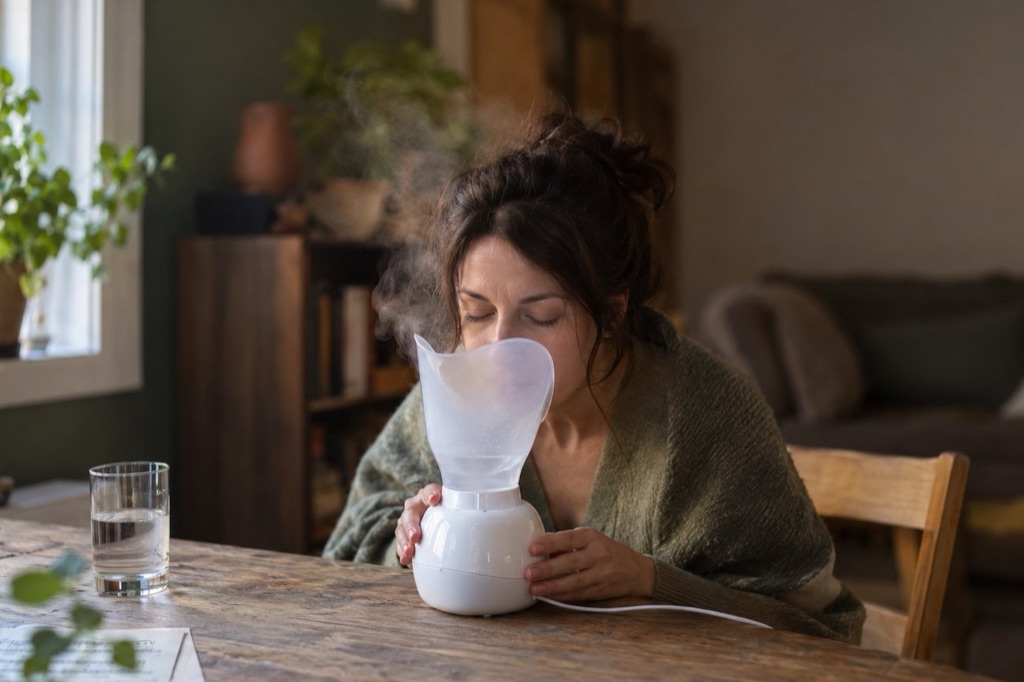
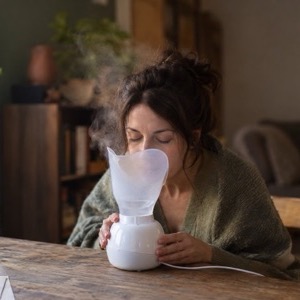
Then came 3 minutes of steam, inhaled through the mouth from a facial steamer. The three measures moved back toward baseline, and the authors report a significant improvement from the post-dehydration values: mean jitter fell to 0.48% and mean shimmer to 2.70 dB, and mean HNR rose to 20.10 (P below 0.05 for each). The paper is labeled level of evidence 4.
The finding leaves several things open:
- Toward baseline is not better than baseline. The study describes recovery from a dry state it created, not a gain on top of a normal voice.
- How long it lasted. The abstract does not state this. It describes recordings at baseline, immediately after the mouth breathing and immediately after the steam, and none later.
- What would have happened without steam. The abstract does not mention a comparison group that simply rested. If no one did, the study cannot separate steam from recovery that would have happened anyway.
The warm-up study: mixed results, and some people disliked steam
Keltz and McHenry (Journal of Voice, 2022) compared three morning warm-ups in 12 women: 3 minutes of steam, 3 minutes of phonating through a straw into water, or both. The lab measure was phonation threshold pressure (PTP), taken before and immediately after each warm-up; a drop in PTP was counted as favorable.
Results were highly variable. Of the 7 participants whose data were analyzed, steam was the best option for 1 and the worst for 3, and those 3 strongly disliked it. The authors concluded that these strategies are not universally successful.
The other 5 were left out of that comparison because their sound pressure level went above 67 dB in at least one of the three pre-warm-up measurements, which the investigators took to mean the PTP task had not been performed as softly as possible. Among the 7, the straw exercise was the best option for 3 and the worst for 1, and the combination was the best for 3 and the worst for 2; the abstract names a worst option for only 6 of the 7. The abstract also describes a trend: in six data points PTP fell even though sound pressure level rose, which the authors read as a possible gain in vocal efficiency. Three of those six were after steam, two after the combination and one after the straw exercise. If steam feels unpleasant to you, that reaction is in the research too.
What the systematic review concluded
Alves and colleagues published a systematic review in the Journal of Voice in 2019. Three conclusions in its abstract matter here:
- Systemic hydration (drinking fluids) was the easiest and most cost-effective approach.
- Only nebulization of an isotonic solution decreased phonation threshold pressure, a lab measure that also appears in the saline studies below.
- Steam inhalation improved NHR (noise-to-harmonics ratio), shimmer and jitter.
So the review credits steam with a change in the same kind of acoustic measures as the 2016 lab study. The abstract does not state how many steam studies stand behind that line, so we cannot tell you whether it adds evidence beyond that one experiment. And the option it rates easiest and most cost-effective is systemic hydration, not steam.
The saline-mist studies are a separate body of work
The second conclusion is about nebulizers, not steamers. The review's abstract does not state which studies it drew on. Three nebulized-saline studies in our sources are mixed as well:
- Tanner et al., 2007. Sixty vocally healthy women breathed dry air for 15 minutes, then received nebulized isotonic saline, hypertonic saline, sterile water or no treatment. No nebulized treatment significantly enhanced recovery of phonation threshold pressure; there was a temporary trend toward reduction with isotonic saline.
- Tanner et al., 2010. In 34 classically trained sopranos who had breathed dry air for 15 minutes, perceived phonatory effort returned to baseline only after isotonic saline, not after sterile water or no treatment, and phonation threshold pressure (PTP) did not change significantly.
- Tanner et al., 2016. In 10 male trained singers and 10 male nonsingers who had breathed dry air for 30 minutes, self-rated effort and dryness improved after nebulized saline, with no consistent change in phonation threshold pressure or in the acoustic measure.
Mayluck's store blog covers this research in its article on portable nebulizers for singers; Mayluck is sold by the company that owns this site. Our own side-by-side is vocal steamer vs. nebulizer.
In one survey, steam was among the most common remedies
MacDonald, You and Fung (Journal of Voice, 2024) surveyed 288 professional voice users in Canada (ACTRA, NATS, Canadian Actors' Equity and vocal performance at Western University). Of those, 86% had used at least one complementary or alternative remedy for voice loss or a negative voice change. The most common were hot drinks with honey and/or lemon, lozenges, and inhaling steam. Voice teachers and doctors most often influenced the choice.
The abstract gives no separate percentage for steam. And a survey records what people do, not whether it works.
The limits of this evidence
- Small groups. 45 women in the lab study; 12 in the warm-up study.
- Women only; healthy voices in the lab study. The lab study recruited vocally healthy women aged 18 to 30. The warm-up study also enrolled only women; the abstract does not state whether their voices were healthy. None of the abstracts we read describes a steam study in people with a voice disorder.
- Short sessions. Steam lasted 3 minutes in both studies. We found no study in our sources of regular steaming over weeks or months.
- Dryness produced on purpose. The lab study dried voices out before steaming. That is not the same as steaming a voice that was not dry to begin with.
- Acoustic measures, not performance. A shift in jitter, shimmer or HNR is not the same as singing better.
- No timing research. We found no study or clinic leaflet on how long to wait after steaming before singing, talking or eating. See how long to steam your voice.
Whether steam physically reaches the vocal folds
We found no direct evidence in the sources we checked: none of the study abstracts we read reports measuring where inhaled steam ends up. One NHS leaflet (West Suffolk, "Practical voice care") is subtitled "Moisturising the vocal folds"; that is patient advice, not a measurement. So we are not going to explain a mechanism we cannot source.
Clinics suggest steam, but not the same routine
Steam appears in NHS voice-care leaflets written for patients, so some clinics do suggest it. A leaflet is advice, not a trial, and these do not agree:
| NHS trust | Leaflet or page | Steam advice |
|---|---|---|
| Royal Berkshire | Voice care tips for a healthy voice | Twice a day for 10 minutes, for a dry throat |
| St George's | Voice Care, for voice difficulties related to head and neck cancer treatment | 3–4 times a day for 2–3 minutes |
| West Suffolk | Practical voice care | Once or twice a day for 10–15 minutes |
| Guy's and St Thomas' | Recovering from vocal cord surgery | Every day, 5 to 10 minutes |
| Sherwood Forest | Vocal hygiene: Caring for your voice | Listed for a dry throat; no minutes or frequency given |
If you are under the care of a voice clinic, follow your own clinician's instructions.
Are vocal steamers safe?
We found no study in our sources that set out to test the safety of vocal steamers. One risk our sources do document is burns. The EPA's guidance on home humidifiers, which does not mention steam inhalers, says of steam vaporizer humidifiers that steam and boiling water may cause burns, and that they should be kept out of the reach of children.
The leaflets differ here too. Guy's and St Thomas' says not to use water that has just boiled and to keep your head about 20 to 25 cm (8 to 10 inches) from the water. West Suffolk, describing a steam-inhaling mug, uses just-boiled water and tells you to be extremely careful with it. For a device, follow its manual; see how to use a vocal steamer. Nothing in this article is a recommendation for children.
If a vocal steamer makes you cough
Stop, and ask a doctor before you try again. We give no medical explanation here; that is a question for someone who can examine you.
Separately, the NIDCD advises seeing a doctor if you have been hoarse for more than three weeks (especially without a cold or flu), are coughing up blood, have trouble swallowing or breathing, feel a lump in your neck, have pain when speaking or swallowing, or lose your voice completely for more than a few days.
What a reasonable singer can take from this
- Steam is common practice, not proven. It shows up in a survey of Canadian professional voice users and in clinic leaflets; for what was measured, see the lab study above.
- Your response may differ. If it feels bad, or you simply do not like it, stopping is consistent with the evidence.
- It is not a fix for a voice problem. For lasting hoarseness, use the NIDCD list above.
- Do not skip the basics. The 2019 review rated systemic hydration easiest and most cost-effective, and the NIDCD's voice-care advice includes drinking water and taking vocal naps. If you do steam, be careful with hot water.
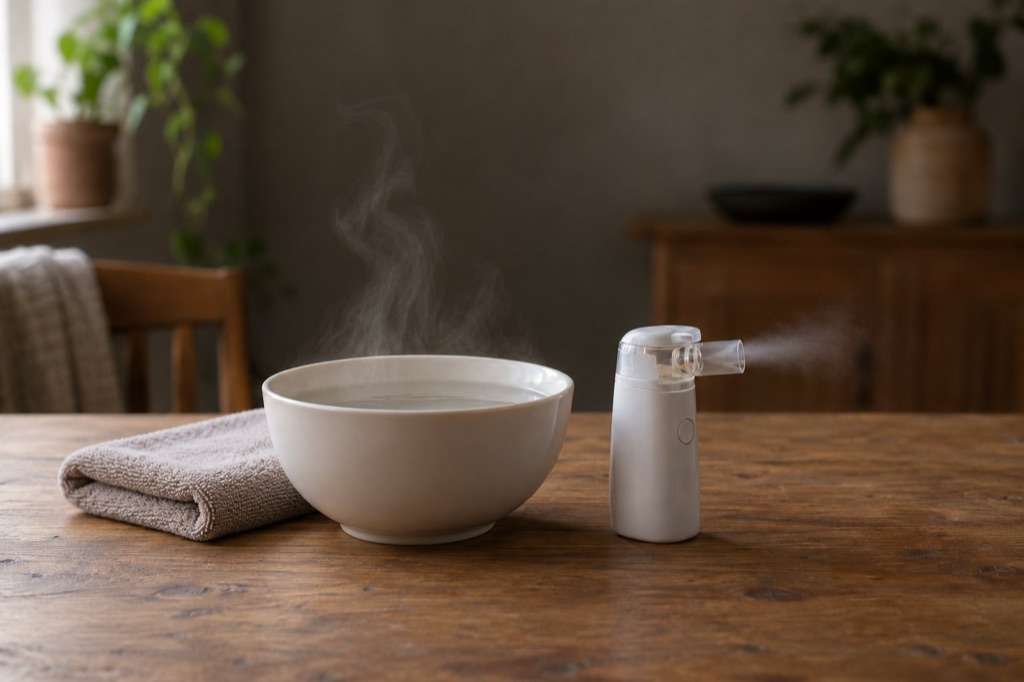
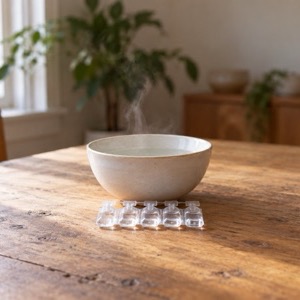
- The research does not single out a device. The lab study used a facial steamer, and the leaflets describe a bowl and towel or a steam-inhaling mug; we found no study comparing a purpose-built vocal steamer with any of them. See what a vocal steamer is and the bowl method.
Questions
Is steam good for your vocal cords?
Possibly, in a limited sense. In one lab study of 45 vocally healthy women, acoustic voice measures moved back toward baseline after 3 minutes of steam that followed about 10 minutes of mouth breathing. No study in our sources shows that steam treats a voice problem.
Do vocal steamers work?
The research is about steam, not a particular product. One small lab study reported acoustic measures moving back toward baseline when 3 minutes of steam followed about 10 minutes of mouth breathing; a warm-up study found varied results, with steam the worst option for 3 of 7 analyzed participants.
Are vocal steamers worth it?
The research cannot settle that. We found no study comparing a purpose-built vocal steamer with a bowl of hot water, so the evidence does not tell you a device does more. What is left is price and convenience.
Are vocal steamers bad for your voice?
We found no study in our sources designed to test whether steaming harms the voice. In the one warm-up study, steam was the worst of three options for 3 of the 7 analyzed participants, who strongly disliked it; the comparison was of the change in phonation threshold pressure (PTP), a lab measure, and the abstract does not give those three participants' figures. One risk our sources do document is burns from steam and hot water. If steaming makes you cough, stop and ask a doctor.
Sources
- Mahalingam & Boominathan, 2016, Laryngoscope (PubMed): lab study of steam inhalation and acoustic voice measures
- Keltz & McHenry, 2022, Journal of Voice (PubMed): steam and straw-in-water phonation as a morning warm-up
- Alves et al., 2019, Journal of Voice (PubMed): systematic review of hydration and the voice
- MacDonald, You & Fung, 2024, Journal of Voice (PubMed): survey of Canadian professional voice users
- Tanner et al., 2007, Journal of Speech, Language, and Hearing Research (PubMed): nebulized saline, hypertonic saline and water after dry air
- Tanner et al., 2010, Journal of Speech, Language, and Hearing Research (PubMed): nebulized isotonic saline versus water in sopranos
- Tanner et al., 2016, Journal of Voice (PubMed): nebulized isotonic saline in male singers and nonsingers
- NIDCD, "Hoarseness": when to see a doctor
- NIDCD, "Taking Care of Your Voice": general voice-care advice
- EPA, "Use and Care of Home Humidifiers": burn warning for steam vaporizer humidifiers
- Royal Berkshire NHS Foundation Trust, "Voice care tips for a healthy voice" (August 2025): patient leaflet, checked October 11, 2026
- St George's University Hospitals NHS Foundation Trust, "Voice Care" (published October 2023): head and neck cancer patient leaflet, checked October 11, 2026
- West Suffolk NHS Foundation Trust, "Practical voice care" (issued August 17, 2026): patient leaflet, checked October 11, 2026
- Guy's and St Thomas' NHS Foundation Trust, "Recovering from vocal cord surgery" (last reviewed March 2024): patient web page, checked October 11, 2026
- Sherwood Forest Hospitals NHS Foundation Trust, "Vocal hygiene: Caring for your voice" (revised December 2025): patient leaflet, checked October 11, 2026
- Mayluck product listings (mayluck.store): features and kit contents, read October 8, 2026