
This library summarizes the eleven published studies our articles cite on steam, nebulized saline and humidity for the voice. Each entry says who was studied, what was done, what was measured, what was found and where the limits are, and links to the PubMed record.
How to read this page
- Every summary is drawn from the study's PubMed abstract, not from the full paper. The abstracts were retrieved October 8, 2026, and re-read on October 13, 2026. Where the abstract does not state a detail, the entry says so.
- Nine of the eleven are experiments, with between 12 and 60 participants each. The other two are a systematic review and a survey.
- The entries describe what researchers measured. They are not treatment advice. Saline volumes and concentrations are study protocols, not doses to copy; for anything prescribed, ask your doctor.
- Abbreviations: PTP is phonation threshold pressure, HNR is harmonics-to-noise ratio, NHR is noise-to-harmonics ratio, SOVT is semi-occluded vocal tract.
The eleven studies at a glance
| Study | Topic | Who | Result in brief |
|---|---|---|---|
| Mahalingam & Boominathan, 2016 | Steam | 45 vocally healthy women aged 18 to 30 | After mouth breathing, 3 minutes of steam brought jitter, shimmer and HNR back toward baseline |
| Keltz & McHenry, 2022 | Steam | 12 women, 7 analyzed | Highly variable; steam was best for 1 and worst for 3 |
| Tanner et al., 2007 | Nebulized saline | 60 vocally healthy women | No nebulized treatment significantly enhanced PTP recovery |
| Tanner et al., 2010 | Nebulized saline | 34 classically trained sopranos | Perceived phonatory effort returned to baseline only after isotonic saline; PTP did not change significantly |
| Tanner et al., 2016 | Nebulized saline | 10 male trained singers and 10 male nonsingers | Self-rated effort and dryness improved; no consistent change in PTP or the acoustic measure |
| Santana, Masson & Araújo, 2017 | Nebulized saline | 27 public-school teachers in Brazil | Reduction in overall voice alteration not statistically significant |
| Levendoski, Sundarrajan & Sivasankar, 2014 | Humidity | 40 healthy adults | After 2 hours of mouth breathing, PTP rose in low humidity and returned toward baseline in high humidity |
| Sundarrajan et al., 2017 | Humidity | 13 healthy adults over 65 | Moderate ambient humidity significantly alleviated increases in perceived effort and vocal tiredness |
| Sandage, Connor & Pascoe, 2014 | Humidity | 15 adults | No significant differences in PTP or perceived effort |
| Alves et al., 2019 | Systematic review | Studies of adults; the abstract does not state how many | Only nebulized isotonic solution decreased PTP; steam improved NHR, shimmer and jitter |
| MacDonald, You & Fung, 2024 | Survey | 288 professional voice users in Canada | Inhaling steam was among the most common remedies respondents used |
Steam
Mahalingam & Boominathan, 2016
- Journal: The Laryngoscope
- Who was studied: 45 vocally healthy women aged 18 to 30.
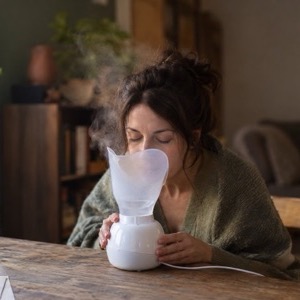
- What was done: About 10 minutes of mouth breathing as a dehydration step, then 3 minutes of steam inhaled through the mouth from a facial steamer.
- What was measured: Jitter, shimmer and HNR.
- What was found: Mouth breathing raised jitter and shimmer and lowered HNR. Steam brought these measures back toward baseline, a significant improvement from the post-dehydration values. Mean jitter was 0.42% at baseline, 1.57% after mouth breathing and 0.48% after steam; mean shimmer was 2.20 dB, 4.73 dB and 2.70 dB; mean HNR was 21.60, 18.64 and 20.10.
- Limits: All participants were vocally healthy women aged 18 to 30. The steam followed a deliberate drying step, and the result is a return toward baseline. Level of evidence 4.
- Link: PubMed 26972609
Keltz & McHenry, 2022
- Journal: Journal of Voice
- Who was studied: 12 women; 7 were analyzed.
- What was done: A morning warm-up comparing 3 minutes of steam, 3 minutes of straw-in-water (SOVT) phonation, or both.
- What was measured: PTP, before and immediately after each condition. Participants also described each condition and how their voice felt afterward.
- What was found: Results were highly variable. Of the 7 participants analyzed, steam was the best strategy for 1 and the worst for 3, and those 3 strongly disliked it. The authors' conclusion is that the strategies are not universally successful.
- Limits: Twelve women, of whom seven were analyzed. Results varied from person to person.
- Link: PubMed 32988703
Nebulized saline
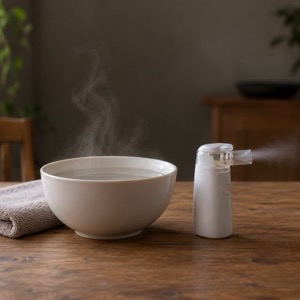
A nebulizer turns a liquid into a mist that you breathe in. The four studies below nebulized saline after a drying step: dry air in the three Tanner studies, mouth breathing in the Santana study. For the nebulizer side of this topic, the store for Mayluck nebulizers, which are sold by the company that owns this site, publishes a guide to portable nebulizers for singers.
Tanner et al., 2007
- Journal: Journal of Speech, Language, and Hearing Research
- Who was studied: 60 vocally healthy women, 15 per group.
- What was done: A double-blind randomized trial. After 15 minutes of dry air (less than 1% relative humidity), each group received nebulized isotonic saline (0.9%), nebulized hypertonic saline, nebulized sterile water, or no treatment.
- What was measured: PTP and perceived effort.
- What was found: PTP rose after the dry air. No nebulized treatment significantly enhanced PTP recovery. There was a temporary trend toward lower PTP with isotonic saline. Perceived effort unexpectedly decreased after the dry-air challenge.
- Limits: A null result for PTP recovery. All participants were vocally healthy women. The abstract does not state how much liquid was nebulized or for how long.
- Link: PubMed 17538106
Tanner et al., 2010
- Journal: Journal of Speech, Language, and Hearing Research
- Who was studied: 34 classically trained sopranos.
- What was done: A double-blind crossover study. After 15 minutes of dry air, 3 mL of nebulized isotonic saline was compared with sterile water and with no treatment.
- What was measured: Perceived phonatory effort and PTP, every 15 minutes from baseline through 2 hours after the dry air.
- What was found: Perceived phonatory effort returned to baseline only after isotonic saline, and PTP did not change significantly.
- Limits: One voice type, 34 people. Perceived effort is the singer's own rating, and PTP did not change significantly.
- Link: PubMed 20699338
Tanner et al., 2016
- Journal: Journal of Voice
- Who was studied: 10 male trained singers and 10 male nonsingers.
- What was done: 30 minutes of dry air, then 3 or 9 mL of nebulized 0.9% saline.
- What was measured: Self-rated effort and dryness, PTP, and an acoustic measure.
- What was found: Self-rated effort and dryness improved. There was no consistent change in PTP or the acoustic measure.
- Limits: Twenty participants. The improvements were self-rated; PTP and the acoustic measure did not change consistently.
- Link: PubMed 26412295
Santana, Masson & Araújo, 2017
- Journal: Journal of Voice
- Who was studied: 27 public-school teachers in Brazil.
- What was done: 5 minutes of nebulized 0.9% saline daily before teaching, for 4 weeks (after 10 minutes of mouth breathing).
- What was measured: Overall voice alteration and acoustic measures.
- What was found: The reduction in overall voice alteration was not statistically significant. Some acoustic measures changed. The authors concluded there was improvement.
- Limits: Twenty-seven teachers. The reduction in overall voice alteration did not reach statistical significance, although the authors concluded improvement.
- Link: PubMed 27765431
Humidity
These three studies are about the humidity of the air people breathe and speak in.
Levendoski, Sundarrajan & Sivasankar, 2014
- Journal: Annals of Otology, Rhinology & Laryngology
- Who was studied: 40 healthy adults.
- What was done: 2 hours of mouth breathing in low humidity and 2 hours of mouth breathing in high humidity.
- What was measured: PTP.
- What was found: PTP rose after 2 hours of mouth breathing in low humidity and returned toward baseline after 2 hours of mouth breathing in high humidity.
- Limits: Healthy adults only. The exposures lasted 2 hours each, and the abstract does not state the humidity levels.
- Link: PubMed 24690983
Sundarrajan et al., 2017
- Journal: Journal of Voice
- Who was studied: 13 healthy adults over 65.
- What was done: 45 minutes of loud child-directed speech in background noise. Each participant did this once in low humidity and once in moderate humidity.
- What was measured: PTP, two acoustic measures (cepstral peak prominence and low/high spectral ratio), perceived phonatory effort and perceived vocal tiredness, before and after the speaking task.
- What was found: The speaking task produced statistically significant changes in PTP, perceived phonatory effort and perceived vocal tiredness. Moderate ambient humidity significantly alleviated the increases in perceived phonatory effort and vocal tiredness; the abstract does not report this for PTP. Moderate humidity also significantly improved cepstral peak prominence, both before and after the speaking task.
- Limits: Thirteen participants, all healthy and over 65. Both outcomes that humidity alleviated are perceived by the speaker.
- Link: PubMed 28238589
Sandage, Connor & Pascoe, 2014
- Journal: Journal of Speech, Language, and Hearing Research
- Who was studied: 15 adults.
- What was done: 20-minute exposures to five realistic temperature and humidity environments.
- What was measured: Upper airway temperature, PTP and perceived effort.
- What was found: No significant differences in any of the three measures.
- Limits: A null result in 15 adults with 20-minute exposures.
- Link: PubMed 23900031
Reviews and surveys
Alves et al., 2019
- Journal: Journal of Voice
- Who was studied: This is a systematic review of studies in adults. The abstract does not state how many studies or participants it covered.
- What was done: A systematic review. Five databases were searched for peer-reviewed articles from the previous 10 years on hydration and voice quality in adults, and the included studies were scored for level of evidence, quality and risk of bias.
- What was measured: The outcomes named in the abstract are jitter, shimmer, NHR, frequency, the s/z ratio, maximum phonation time, PTP and perceived phonatory effort.
- What was found: Systemic hydration was the easiest and most cost-effective approach. Only nebulization of isotonic solution decreased PTP. Steam inhalation improved NHR, shimmer and jitter.
- Limits: A review is a summary of other studies. Set its PTP statement beside the single trials above: Tanner 2007 found no nebulized treatment significantly enhanced PTP recovery, Tanner 2010 found no statistically significant change in PTP, and Tanner 2016 found no consistent change in PTP.
- Link: PubMed 29122414
MacDonald, You & Fung, 2024
- Journal: Journal of Voice
- Who was studied: 288 professional voice users in Canada, from ACTRA, NATS, Canadian Actors' Equity and Western University vocal performance.
- What was done: A national cross-sectional survey about the products and therapies respondents use for vocal health.
- What was measured: Which complementary or alternative remedies respondents had used, and who influenced the choice.
- What was found: 86% said they had used at least one complementary or alternative remedy when experiencing voice loss or a negative voice change. The most common were hot drinks with honey and/or lemon, lozenges, and inhaling steam. Voice teachers and doctors most often influenced the choice.
- Limits: A survey records what people use. It does not test whether any remedy works.
- Link: PubMed 34465479
What public health bodies say
These three pages were checked October 8, 2026.
NIDCD, "Taking Care of Your Voice." Drink water, take vocal naps, and use a humidifier, with about 30% humidity as the figure given.
NIDCD, "Hoarseness." See a doctor if you have been hoarse for more than three weeks (especially without a cold or flu), if you are coughing up blood, if you have trouble swallowing or breathing, if you have a lump in your neck, if it hurts to speak or swallow, or if you lose your voice completely for more than a few days.
EPA, "Use and Care of Home Humidifiers." This page is about home humidifiers:
- Empty the tank, wipe all surfaces dry and refill portable humidifiers daily.
- Use water with low mineral content, such as distilled water.
- Clean portable humidifiers every third day.
- Do not humidify above 50% relative humidity.
- Keep steam vaporizers out of the reach of children. Steam and boiling water may cause burns.
- Ultrasonic and impeller ("cool mist") humidifiers can disperse microorganisms and minerals.
What we could not find
- How long to wait after steaming before singing, talking or eating. We found no study on it, and none of the five NHS leaflets we read states it.
- A comparison of steam durations or frequencies. Both steam studies above used 3 minutes. None of the five NHS leaflets cites a study comparing durations or frequencies.
If you know of a study that belongs here, or think a summary is wrong, tell us through the contact page.
Sources
The PubMed record for each of the eleven studies is linked in its entry above. The other sources on this page:
The five NHS leaflets, checked October 11, 2026:
- Guy's and St Thomas' NHS Foundation Trust, "Recovering from vocal cord surgery"
- Royal Berkshire NHS Foundation Trust, "Voice care tips for a healthy voice"
- St George's University Hospitals NHS Foundation Trust, "Voice Care"
- West Suffolk NHS Foundation Trust, "Practical voice care"
- Sherwood Forest Hospitals NHS Foundation Trust, "Vocal hygiene: Caring for your voice"