

 VocalSteamer Editorial Team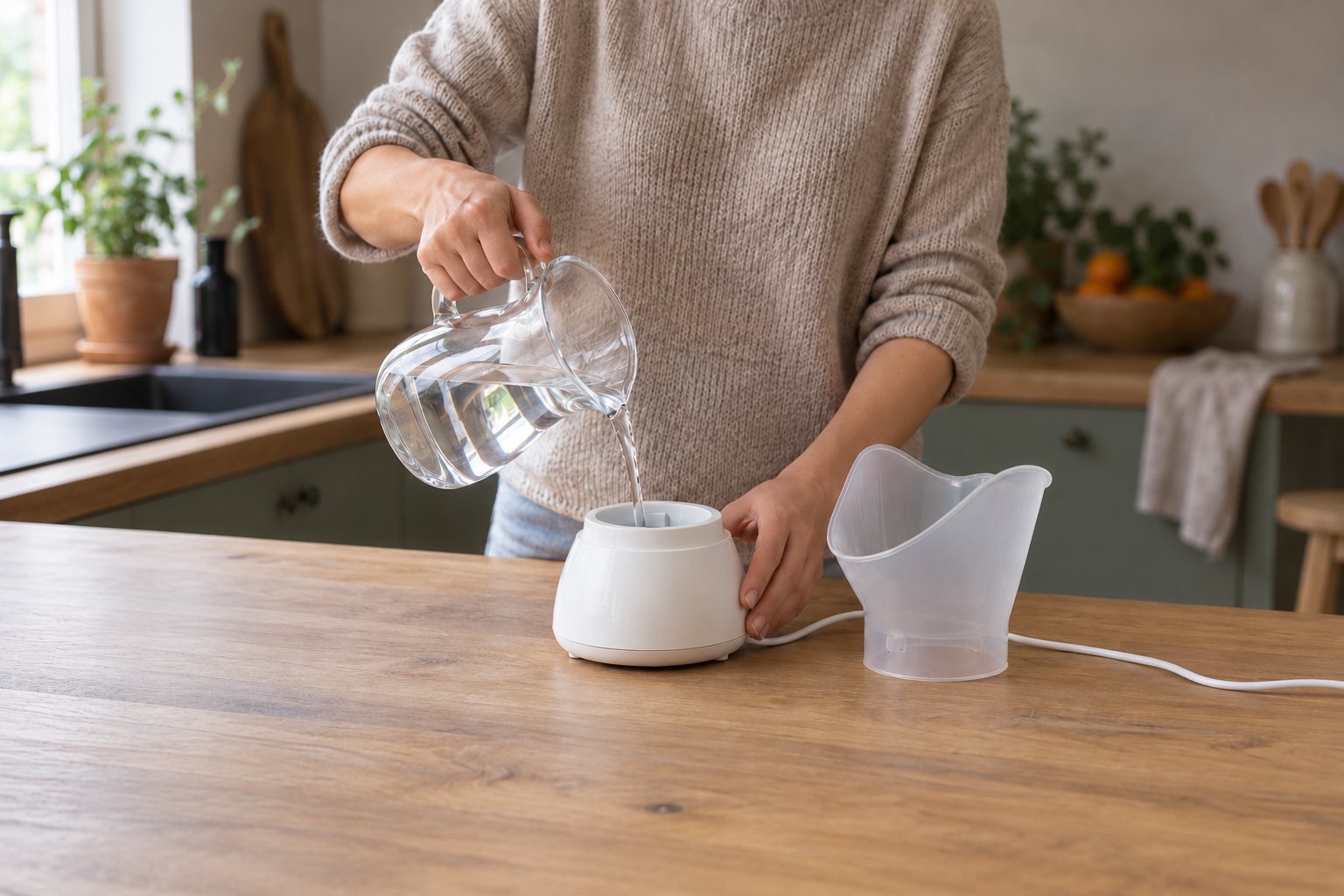
To use a vocal steamer, fill it with the water its manual names and nothing else, switch it on, and breathe normally at the hood or mask for the time the manual gives. Then switch it off and finish the way the manual says: the Vicks V1200 is left to cool, emptied and wiped dry, while MyPurMist devices run their own 10-minute drying cycle. The details differ by device (one maker specifies tap water, another sterile refills only), so your own manual comes first.
The steps below come from the makers' instructions for the Vicks Personal Steam Inhaler V1200 and the MyPurMist Free, Mypurmist 2 and Classic; we have not used any of them. MyPurMist's documents were checked on October 11, 2026. The Vicks site did not load that day, so the V1200 manual was read in a copy archived on May 19, 2024.
The V1200 is a corded unit that stands on a flat surface and boils water; its manual warns that the reservoir and the water get extremely hot. MyPurMist devices are handheld, and the maker states a steam temperature of about 100 to 115°F.
How to use a vocal steamer, step by step
1. Set it up where it can stay
V1200: unravel the cord fully and stand the unit on a firm, flat, waterproof surface (never your lap) within reach of a wall outlet; the manual rules out extension cords. MyPurMist: the Mypurmist 2 and Classic plug in. The cordless Free has to be charged first; its guide says a full charge takes about 2 hours and gives 30 minutes of use, and that the device does not run while plugged in.
2. Fill it with the water the manual names
V1200: remove the hood and the vent assembly and fill the reservoir with tap water to just below the rim of the cup (the manual gives no volume or water temperature). MyPurMist Free: squeeze a sealed sterile-water refill into the fill port at the back until it is empty. On a first fill, the Mypurmist 2 guide adds a 30-minute soak and the Classic manual a 30-second one.
3. Close it, switch it on and wait for steam
V1200: lock the vent assembly back on, refit the hood, plug in and switch on. The manual says steam starts in approximately 3 to 5 minutes. MyPurMist says steam is instant on the Free and Mypurmist 2, and its tips sheets say the steam is too fine to see, so do not wait for a visible plume.
4. Set the steam level or temperature
V1200: turn the flow levers counterclockwise, to minimum, before your face goes over the hood. Clockwise gives more steam, which the manual says feels hotter. MyPurMist: the control sets temperature (about 100 to 115°F, per the maker). It is a button with one to four lights on the Free and Classic and a dial on the Mypurmist 2.
5. Breathe normally at the hood or mask
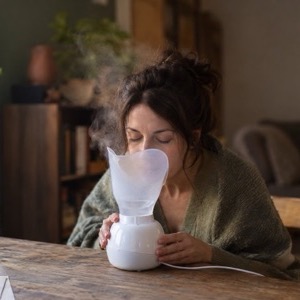
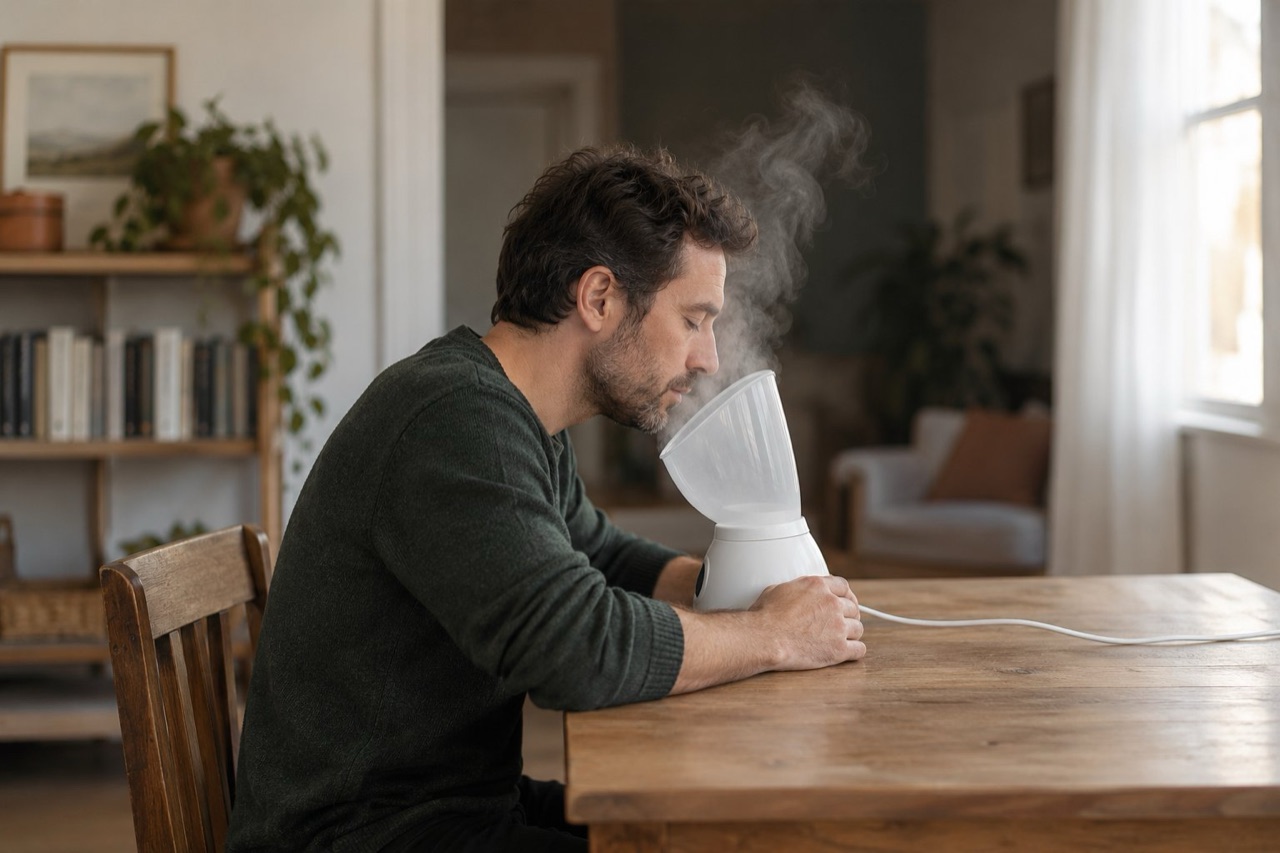
Both makers say to breathe normally. V1200: face over the hood, breathing through your nose and mouth, without resting your face on it; the manual says the soft plastic can bend and tip the unit, spilling boiling water. If it is too warm even on a low setting, lift your face one or two inches. MyPurMist Free: hold the device up to your nose and mouth.
The V1200 manual also says never to move or lift the inhaler while it is in use, to keep it out of reach of children and, like the MyPurMist Free and Mypurmist 2 guides, not to use it while drowsy.
6. How long: what each manual says
The V1200 manual says five to fifteen minutes and leaves how often to you. The MyPurMist Free and Mypurmist 2 guides call 5 to 15 minutes a typical session, twice a day; the Classic manual suggests 10 to 15 minutes twice a day. MyPurMist words these as typical or suggested sessions, not limits; the Classic manual also says the device can be used for any length of time. None of these manuals mentions singing or voice use. NHS leaflets do not agree either (2 to 3 minutes in St George's head and neck cancer leaflet, 10 to 15 in West Suffolk's voice care leaflet); how long to steam your voice sets them side by side.
7. Switch off and follow the manual's after-use routine
V1200: switch off, unplug, and let the unit cool before you move or refill it (at least 20 minutes before cleaning, the manual says). Wipe the hood and vent assembly dry, pour out leftover water and dry the reservoir and base. Never put the base in water. MyPurMist: all three run a 10-minute drying cycle after use; the Mypurmist 2 guide and Classic manual say not to unplug during it. How to clean a vocal steamer has the full routines.
What to put in a vocal steamer
Water of the kind the manual names, with nothing added. No manual below calls for a liquid or solution other than water, and they do not agree on which water:
| Device (maker's document) | Water the maker specifies | What the maker rules out |
|---|---|---|
| Vicks V1200 (manual) | Tap water | Anything added to the water, including medications and inhalant liquids |
| MyPurMist Free and Mypurmist 2 (user guides) | MyPurMist's sealed sterile-water refills only | Any other water, additives or other liquid |
| MyPurMist Classic (manual) | MyPurMist's own water, or distilled water | Additives, other liquids and water with minerals; bottled, purified and boiled water are named |
| Crane EE-5948 cordless (manual, checked October 11, 2026) | Clean drinking or spring water, not hot | Distilled or purified water, essential oils, medication |
Distilled water is allowed in the Classic manual and ruled out in the Crane manual, so do not carry a habit from one steamer to the next.
Oils. Neither the V1200 manual nor MyPurMist's documents mention adding essential oils to the water; their water-only and no-additives wording covers it. Both makers put scent in pads outside the water, and those pads contain eucalyptus oil. For bowl steaming, St George's head and neck cancer leaflet says "plain water only, no oils." Other leaflets differ: Royal Berkshire says you do not need to add anything, and West Suffolk mentions 2 to 3 drops of Olbas or tea tree oil only if you have a cold or throat infection. None of them overrides an electric steamer's manual.
Medicines. The V1200 manual, MyPurMist's warranty page and the Crane manual all rule out medication in the water. For anything prescribed, ask your doctor.
When to stop
Stop if steam makes you cough, and ask a doctor about it. Steam does not suit everyone: in a small warm-up study of 12 women (Keltz & McHenry, 2022), results varied widely. Of the 7 participants analyzed, steam was the best strategy for 1 and the worst for 3, and those 3 strongly disliked it (more on the steam studies).
The NIDCD says to see a doctor if you have been hoarse for more than three weeks (especially without a cold or flu), are coughing up blood, have trouble swallowing or breathing, feel a lump in your neck, have pain when speaking or swallowing, or lose your voice completely for more than a few days.
If you use a nebulizer instead
None of these steps apply to a nebulizer, which heats nothing: it turns the liquid in its cup into a cool mist. In the voice studies that liquid was mostly isotonic (0.9%) saline, and the results were mixed; in Tanner et al. 2007 (60 vocally healthy women, after 15 minutes of breathing dry air), no nebulized treatment (isotonic saline, hypertonic saline or sterile water) significantly improved recovery of phonation threshold pressure. Saline must be sterile and labeled for inhalation or nebulizer use, and prescribed medicines go in only as your doctor directs. For setup, see the first-use guide in the help center for Mayluck nebulizers, which the company that owns this site sells. Vocal steamer vs. nebulizer compares the two devices.
Questions
Can you put saline in a vocal steamer?
Only if its manual says so. The V1200 manual and MyPurMist's documents do not name saline; their water-only and no-other-liquid wording covers it. Vocal steamer with saline goes through what the makers say.
How do you use a Vicks vocal steamer?
Vicks calls its devices steam inhalers, and the Vicks documents we read do not mention singers or the voice. The steps above cover the V1200. The Sinus Inhaler (VIH200) differs: its FAQ, as archived on March 25, 2025, specifies up to 2.5 tablespoons (40 mL) of cool tap water and says steam starts in approximately 6 minutes.
How do you steam your voice at home without a steamer?
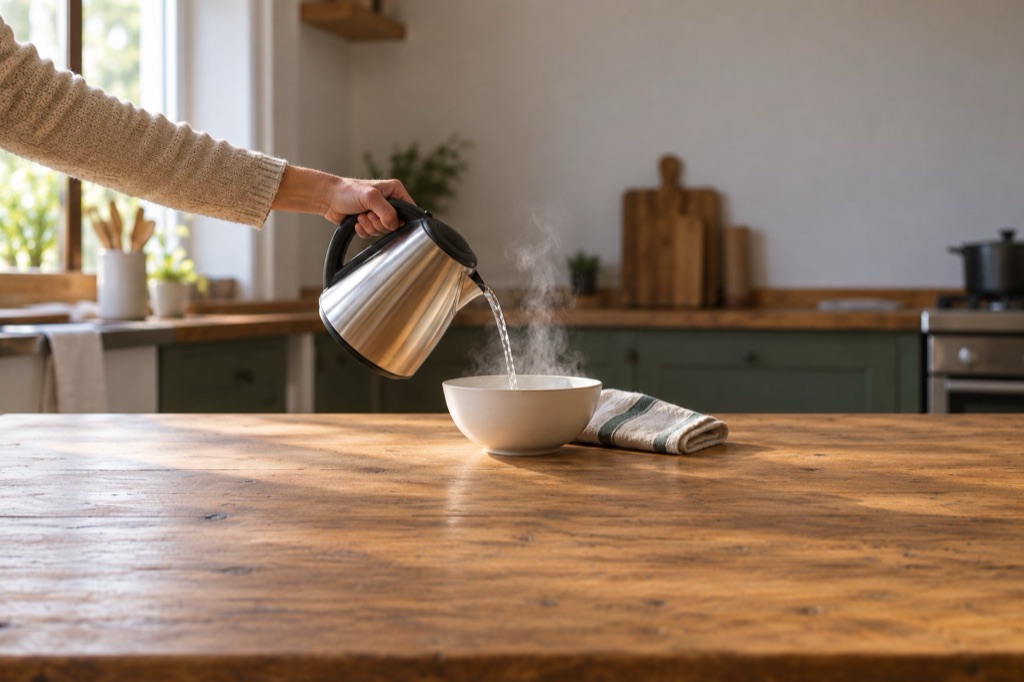
With a bowl of hot water and a towel. The Guy's and St Thomas' NHS page for people recovering from vocal cord surgery describes boiled water that has cooled a little (not water that has just boiled), a towel over your head and the bowl, and your head about 20 to 25 cm (8 to 10 inches) from the water. Other hospitals differ: West Suffolk's leaflet prefers a steam-inhaling mug filled with just-boiled water. DIY vocal steamer sets the leaflets side by side.
Sources
- Vicks Personal Steam Inhaler V1200 Use and Care Manual (Kaz USA, copyright 2021): manufacturer manual, read on October 11, 2026 from the Internet Archive capture of May 19, 2024; the live Vicks site did not load for our check that day
- Vicks Sinus Inhaler FAQs: manufacturer FAQ for the VIH200, read on October 11, 2026 from the Internet Archive capture of March 25, 2025
- MyPurMist Free user guide (PDF): manufacturer guide, checked October 11, 2026
- Mypurmist 2 user guide (PDF): manufacturer guide, checked October 11, 2026
- MyPurMist Classic user manual (PDF): manufacturer manual, checked October 11, 2026
- MyPurMist Free troubleshooting and tips sheet (PDF): manufacturer statements on steam visibility and temperature, checked October 11, 2026
- Mypurmist 2 troubleshooting and tips sheet (PDF): manufacturer tips sheet, checked October 11, 2026
- MyPurMist Classic troubleshooting and tips sheet (PDF): manufacturer tips sheet, checked October 11, 2026
- MyPurMist Free product page and Mypurmist 2 product page: manufacturer statements on temperature and instant steam, checked October 11, 2026
- MyPurMist warranty page: what may go in the water reservoir, including the rule on medication, checked October 11, 2026
- MyPurMist Scentpad product page: what the scent pads contain, checked October 11, 2026
- Crane EE-5948 Personal Steam Inhaler manual (PDF): manufacturer manual, checked October 11, 2026
- St George's University Hospitals NHS Foundation Trust, "Voice Care" (published October 2023): head and neck cancer patient leaflet, checked October 11, 2026
- Royal Berkshire NHS Foundation Trust, "Voice care tips for a healthy voice" (August 2025): patient leaflet, checked October 11, 2026
- West Suffolk NHS Foundation Trust, "Practical voice care" (issued August 17, 2026): patient leaflet, checked October 11, 2026
- Guy's and St Thomas' NHS Foundation Trust, "Recovering from vocal cord surgery" (last reviewed March 2024): patient web page for people having vocal cord surgery, checked October 11, 2026
- Keltz & McHenry, 2022, Journal of Voice (PubMed): steam and straw phonation in a morning warm-up, 12 women
- Tanner et al., 2007, Journal of Speech, Language, and Hearing Research (PubMed): nebulized saline and water after dry air, 60 women
- NIDCD, "Hoarseness": when to see a doctor