

 VocalSteamer Editorial Team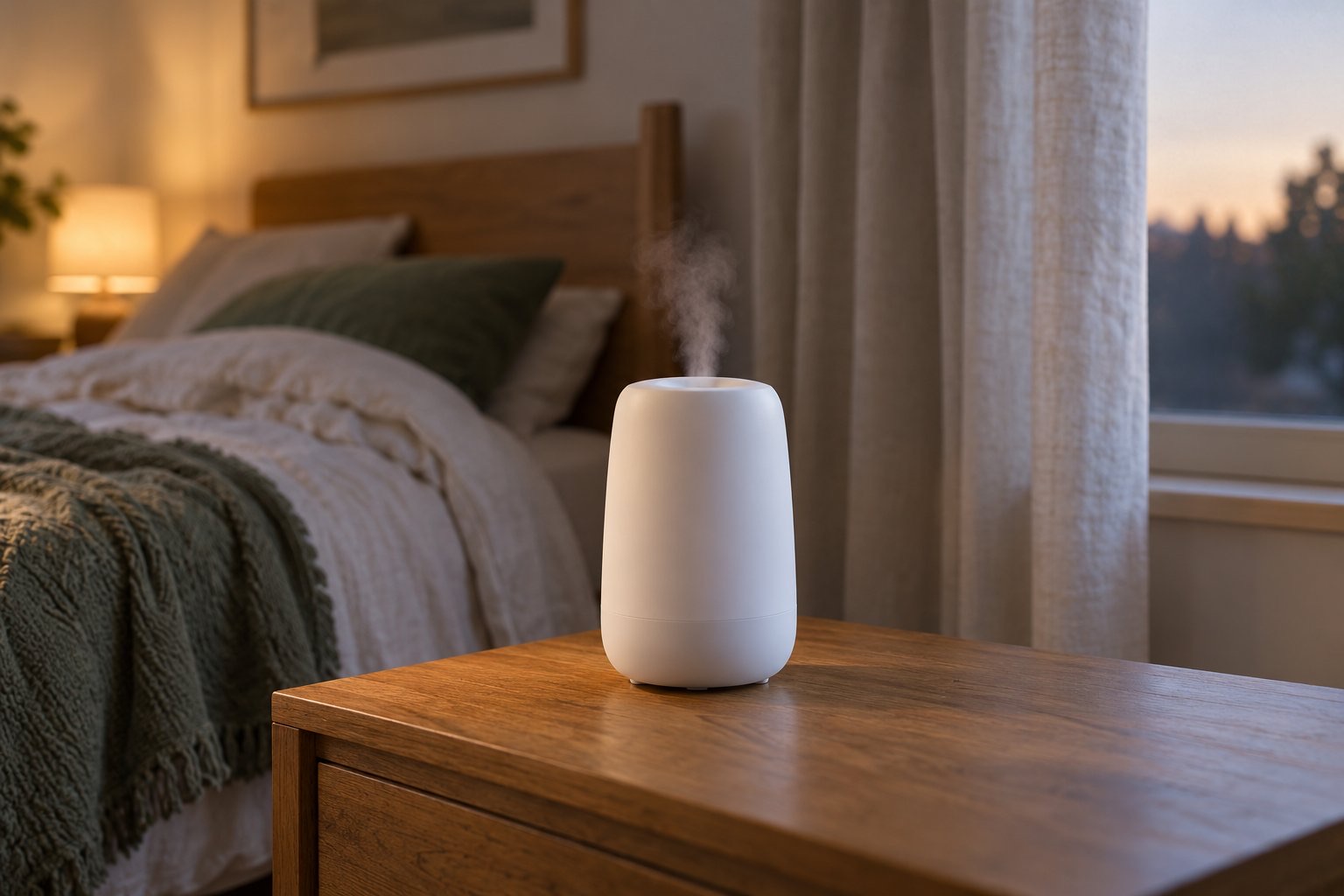
A vocal steamer and a humidifier do different jobs. A steamer gives one person a few minutes of warm, moist air to breathe at close range; a humidifier adds moisture to a whole room for as long as it runs. No study in our research library compared the two, so choose by what you want to change: a few minutes around a rehearsal, or the air you spend hours in.
A session for you, or the air in a room
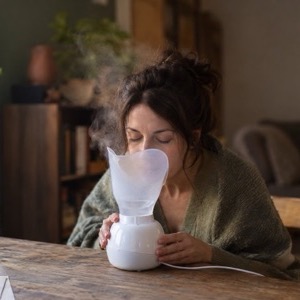
A vocal steamer is something you breathe from directly, for minutes. The Vicks V1200 manual describes its inhaler as adding water vapor for the individual user and sets a treatment at five to fifteen minutes; the Mypurmist Free user guide calls 5 to 15 minutes a typical session. (Manufacturer documents, checked October 11, 2026; the Vicks manual was read from an Internet Archive capture of May 19, 2024, because the maker's site returned a bot check.) NHS leaflets range from 2 to 3 minutes (St George's, writing for people with voice difficulties related to head and neck cancer treatment) to 10 to 15 (West Suffolk); see how long to steam your voice.
A humidifier works on the air, not on you. It adds moisture to a room, and you breathe that air for as long as you are in it.
A "vocal humidifier" is not a device category in any source we read, and labels blur: MyPurMist's store adds the words humidifier and vaporizer to the listed names of two of its steam inhalers (checked October 11, 2026). Go by what a device does. One maker suggests using both: the Vicks V1200 manual recommends a Vicks humidifier or vaporizer to complement its steam inhaler (the maker's own suggestion, for its own products).
What the humidity studies measured
Three studies in our library changed the humidity of the air people breathed or spoke in. (PTP stands for phonation threshold pressure, a measure taken in all three studies.)
| Study | Who and what | Result |
|---|---|---|
| Levendoski, Sundarrajan & Sivasankar, 2014 | 40 healthy adults; 2 hours of mouth breathing in low humidity and 2 hours in high humidity | PTP rose after the 2 hours in low humidity and returned toward baseline after the 2 hours in high humidity. |
| Sundarrajan et al., 2017 | 13 healthy adults over 65; 45 minutes of loud child-directed speech in background noise | PTP, perceived phonatory effort and vocal tiredness all worsened significantly after the task. Moderate ambient humidity significantly alleviated the increases in perceived phonatory effort and vocal tiredness; the abstract does not report that for PTP. |
| Sandage, Connor & Pascoe, 2014 | 15 adults; 20-minute exposures to five realistic temperature and humidity environments | No significant differences in PTP or perceived effort. |
That is two favorable results and one null result, all in small groups, with different exposures and tasks. None of the three abstracts describes any participant as a singer or states how the humidity was produced, so we cannot say any of the three tested a home humidifier. None of the outcomes measures singing.
The steam studies are just as small. Three minutes of steam moved acoustic measures back toward baseline after mouth breathing in 45 vocally healthy women (Mahalingam & Boominathan, 2016). In a morning warm-up study of 12 women, results were highly variable: steam was best for 1 and worst for 3 of the 7 analyzed participants, and those 3 strongly disliked it (Keltz & McHenry, 2022). See does steam help vocal cords?
Humidifier for singers: what the NIDCD and the EPA say
The National Institute on Deafness and Other Communication Disorders (NIDCD) lists a humidifier on its "Taking Care of Your Voice" page, with about 30% humidity as the figure. The US Environmental Protection Agency (EPA), writing about home humidifiers and not about voices, says not to humidify above 50% relative humidity. We found no source that combines the two into one target for singers.
NHS voice leaflets differ on what to try. Royal Berkshire says to consider a humidifier or a damp towel over the radiator. Sherwood Forest suggests houseplants or bowls of water. St George's suggests a bowl of hot water in the corner of the room at night or, if one is available, a humidifier.
A humidifier is a tank you have to look after
The EPA's "Use and Care of Home Humidifiers" page (last updated April 29, 2026) does not mention steam inhalers or voice use. Its main points:
- Every day: unplug a portable humidifier, empty the tank, wipe all surfaces dry and refill, to reduce the growth of microorganisms.
- Every third day: clean it. Empty the tank, scrub it with a brush and remove any scale, deposits or film.
- Water: use low-mineral water, such as distilled, so that minerals are not released into the air.
- "Cool mist" types: ultrasonic and impeller humidifiers can disperse microorganisms and minerals.
- Steam vaporizers (they heat water with an electrical element or electrodes): keep them out of children's reach; steam and boiling water may cause burns.
Do not carry this schedule or the water advice over to a steamer: each maker sets its own, and the Vicks V1200 manual, for one, specifies tap water. See how to clean a vocal steamer. We have not compared humidifier models, so this article names none.
When each fits
| Your situation | What fits | Why |
|---|---|---|
| The room you sleep or practice in stays dry for hours | Humidifier | It works on the room's air while it runs. The NIDCD and EPA figures are given above. |
| You want a few minutes of warm, moist air around a rehearsal or show | Steamer | Sessions are short: 5 to 15 minutes in the Vicks V1200 manual and the Mypurmist Free guide. |
| You will not empty a tank daily and scrub it every third day | A humidifier may not suit you | Daily emptying and cleaning every third day is the EPA's care routine for portable humidifiers. Royal Berkshire's leaflet also offers a damp towel over the radiator. |
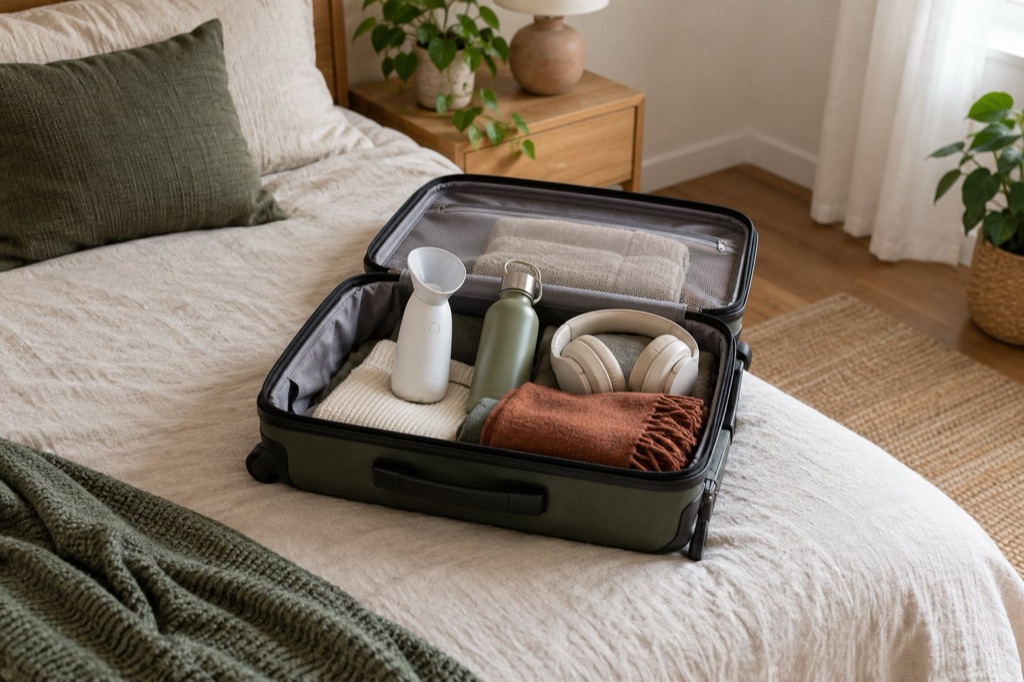
| You are in a dressing room, classroom or hotel room | A personal device you carry | A humidifier only changes the room it sits in. See portable vocal steamers and steaming your voice on tour. |
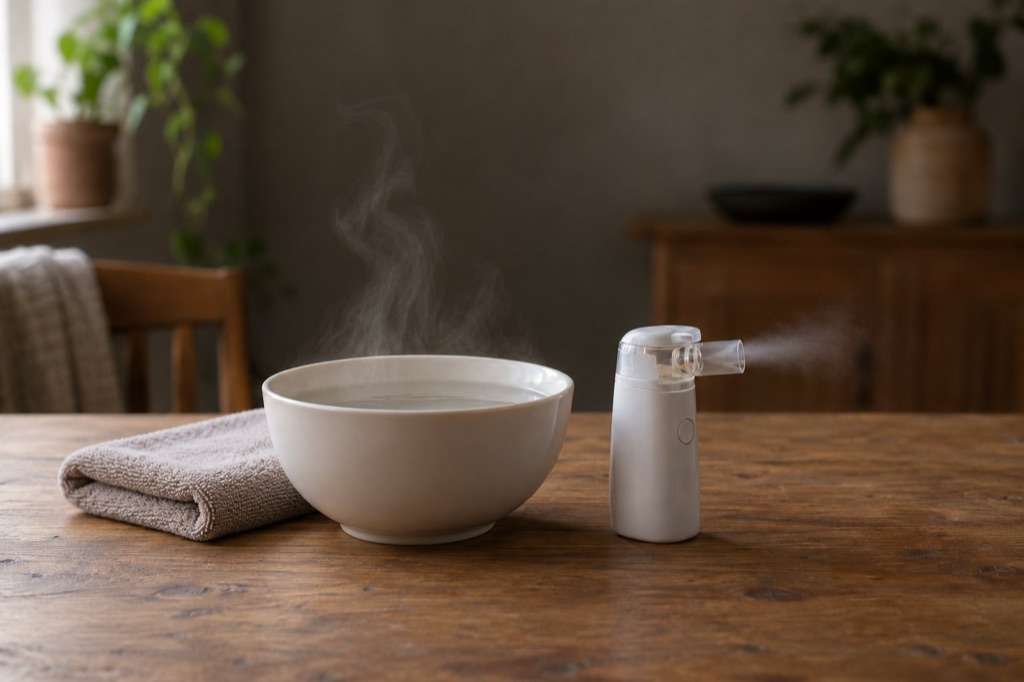
Where a nebulizer differs from both
Like a steamer, a nebulizer is personal and short, but it makes a cool mist from a small amount of liquid. Unlike a humidifier, it does nothing for the room. In the voice studies the liquid was mostly isotonic (0.9%) saline, with mixed results: after 15 minutes of dry air, perceived effort returned to baseline only after isotonic saline in 34 classically trained sopranos, while PTP did not change significantly (Tanner et al., 2010), and in 60 vocally healthy women no nebulized treatment significantly enhanced PTP recovery (Tanner et al., 2007).
Kinmilu, a store run by a company affiliated with this site's owner, lists a rechargeable mesh nebulizer for battery-powered use away from an outlet (store listing, read October 11, 2026); the kit includes no saline. Clean one by its own instructions, not the humidifier schedule above: a help center run by this site's owner covers how the mesh nebulizers that company sells are cleaned, and vocal steamer vs. nebulizer has the full comparison.
When to stop and see a doctor
If steam makes you cough, stop and see a doctor. The EPA says to stop using a humidifier and contact your physician if you have respiratory symptoms you believe are associated with its use.
None of these devices is a way to manage a voice problem that is not going away. The NIDCD says to see a doctor if you have been hoarse for more than three weeks (especially without a cold or flu), are coughing up blood, have trouble swallowing or breathing, feel a lump in your neck, have pain when speaking or swallowing, or lose your voice completely for more than a few days.
Questions
Is a vocal steamer the same as a humidifier?
No. A steamer is a personal device you breathe from for minutes; a humidifier adds moisture to a room's air for as long as it runs. MyPurMist's store, for one, adds the words humidifier and vaporizer to the listed names of two of its steam inhalers (checked October 11, 2026), so go by what a device does.
What humidity should a singer's room be?
We found no figure written for singers. The NIDCD's voice-care page gives about 30% humidity, and the EPA says not to humidify above 50% relative humidity.
Nebulizer vs. humidifier for singers: which one?
They do unrelated jobs. A humidifier changes a room's air; a nebulizer gives one person a cool saline mist for a short session, and battery models work without an outlet. The saline studies include a null result (Tanner et al., 2007).
Sources
- Levendoski, Sundarrajan & Sivasankar, 2014, Annals of Otology, Rhinology & Laryngology (PubMed): mouth breathing in low and high humidity, 40 healthy adults
- Sundarrajan et al., 2017, Journal of Voice (PubMed): ambient humidity during 45 minutes of loud speech, 13 adults over 65
- Sandage, Connor & Pascoe, 2014, Journal of Speech, Language, and Hearing Research (PubMed): five temperature and humidity environments, 15 adults
- Mahalingam & Boominathan, 2016, Laryngoscope (PubMed): steam after mouth breathing, 45 women
- Keltz & McHenry, 2022, Journal of Voice (PubMed): steam and straw phonation in a morning warm-up, 12 women
- Tanner et al., 2010, Journal of Speech, Language, and Hearing Research (PubMed): nebulized isotonic saline in 34 sopranos
- Tanner et al., 2007, Journal of Speech, Language, and Hearing Research (PubMed): nebulized saline and water after dry air, 60 women
- NIDCD, "Taking Care of Your Voice": humidifier and the figure of about 30% humidity
- NIDCD, "Hoarseness": when to see a doctor
- US EPA, "Use and Care of Home Humidifiers": guidance for humidifiers, not steam inhalers; page last updated April 29, 2026
- Royal Berkshire NHS Foundation Trust, "Voice care tips for a healthy voice" (August 2025): patient leaflet
- Sherwood Forest Hospitals NHS Foundation Trust, "Vocal hygiene: Caring for your voice" (revised December 2025): patient leaflet
- St George's University Hospitals NHS Foundation Trust, "Voice Care" (published October 2023): head and neck cancer patient leaflet
- West Suffolk NHS Foundation Trust, "Practical voice care": patient leaflet
- Vicks Personal Steam Inhaler V1200, Use and Care Manual (Kaz USA): manufacturer manual, read on October 11, 2026 from the Internet Archive capture of May 19, 2024
- MyPurMist Free user guide (PDF): manufacturer statements, checked October 11, 2026
- MyPurMist steam inhalers collection page: product names as listed, checked October 11, 2026
- Kinmilu product listing (kinmilu.com): features and kit contents, read October 11, 2026