
 VocalSteamer Editorial Team
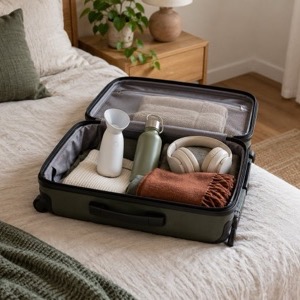
A vocal steamer for travel is only useful when the day supplies what it runs on: a wall outlet, hot water from a kettle or tap, or a battery you charged earlier. A hotel room with a kettle can; a dressing room or a bus may not, and for those stretches the options are a charged cordless steam inhaler or a battery nebulizer, which makes a cool saline mist and is not a steamer. For a plane we state no rule: ask your airline. We have not tested any device named here: the details come from makers' manuals and product pages (checked October 11, 2026, unless another date is given; the Vicks V1200 manual and the Vicks listing from archived copies dated in Sources) and from NHS voice leaflets.
What steaming needs, stop by stop
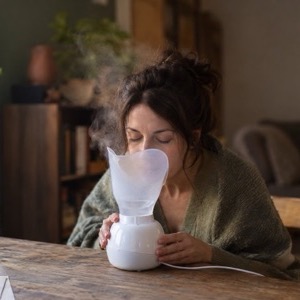
Steaming can need up to four things: hot water (or a device that makes its own steam), power, a steady surface and time. The manual for one plug-in steamer, the Vicks Personal Steam Inhaler V1200 (archived copy of May 19, 2024, see Sources), shows why each matters. The unit boils its own water and plugs directly into a wall outlet, with no extension cord allowed. It has to sit on a firm, flat, waterproof surface, not your lap, and must not be moved in use because it can spill hot water. It takes about 3 to 5 minutes to start steaming, then 5 to 15 minutes of use, then has to cool before you move it.
NHS leaflets differ on how long a session lasts, from 2 to 3 minutes (St George's) to 10 to 15 (West Suffolk); how long to steam your voice sets them side by side.
| Stop | Check first | What is possible |
|---|---|---|
| Hotel room | A kettle or hot tap; an outlet near a table | A bowl or steam mug, a hot shower, or a plug-in steamer if its manual allows use outside the home |
| Dressing room | A wall outlet within reach of the cord (the V1200 manual allows no extension cord); table space away from other people | A plug-in steamer if its manual allows use outside the home, you have both, and there is time to let it cool; otherwise a cordless steam inhaler or a battery nebulizer |
| Bus | Whether it is moving | Nothing that holds hot water while it moves. A charged cordless steam inhaler or a battery nebulizer needs no outlet and no hot water added, but we have no maker instruction on file about use in a vehicle. |
| Plane | Your airline's rules, before you pack | We state no rule; see below |
Hotel room
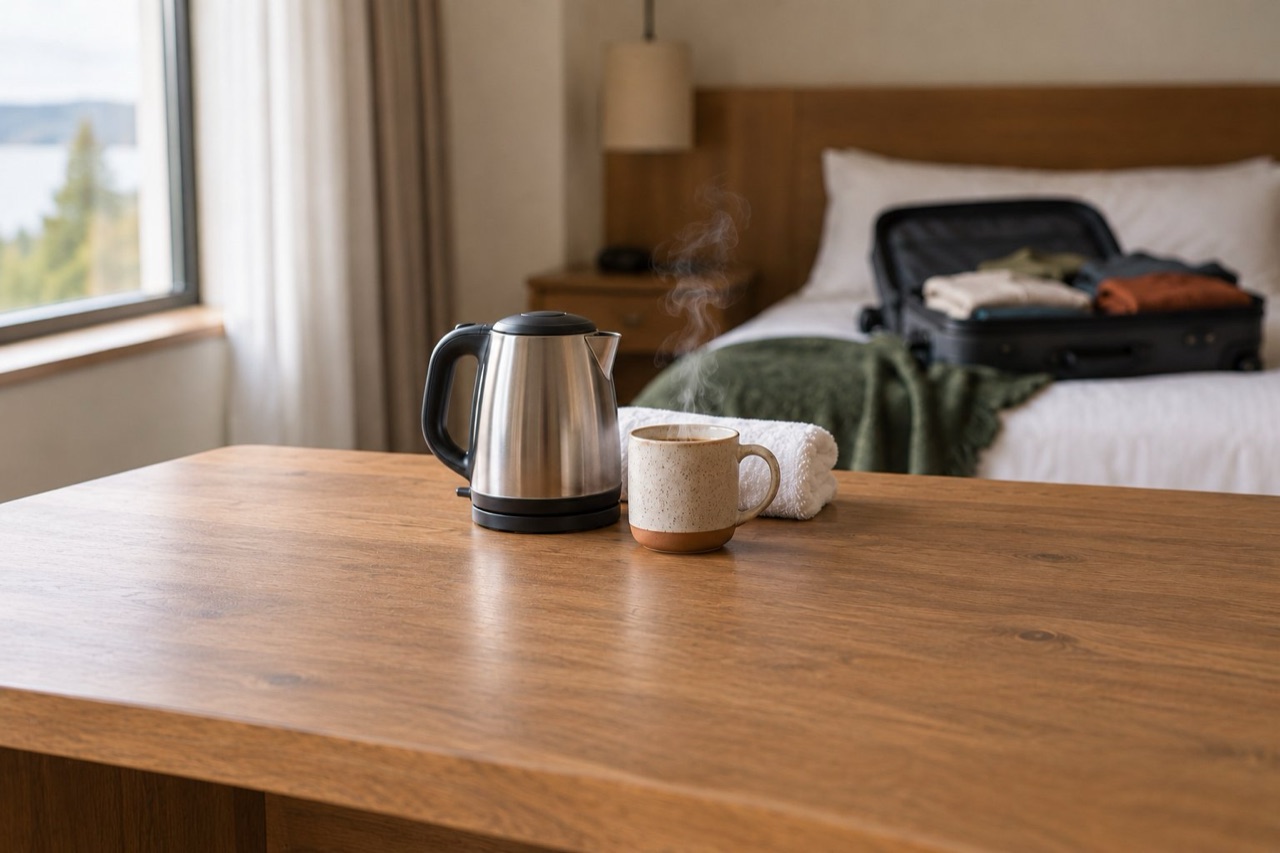
With a kettle, you can follow the leaflet methods, but the leaflets disagree about the water. Guy's and St Thomas', on a page for people recovering from vocal cord surgery, describes a bowl of boiled water that has cooled a little, a towel over your head, and your head about 20 to 25 cm (8 to 10 inches) from the water for 5 to 10 minutes; it says not to use water that has just boiled. West Suffolk prefers a steam-inhaling mug filled with just-boiled water from the kettle and tells you to be extremely careful with it.
St George's, in a leaflet for people with voice difficulties related to head and neck cancer treatment, says plain water only, no oils, and adds that you can inhale over a hot cup of tea or in a hot shower or bath. West Suffolk also describes steaming before bed, including after you have been out somewhere noisy or smoky. DIY vocal steamer has the method and the safety points.
Abroad, check the voltage as well as the plug shape. The Mypurmist Free guide says its charger can be used worldwide (100-240V, 50/60 Hz); the Crane EE-5948 manual prints both a charging step naming a 120V outlet and an adaptor note saying its charger is 100-240V, 50/60 Hz and can be used worldwide, though you may need an outlet adaptor in some countries. The V1200 manual prints both a travel note saying the unit adjusts from 120 to 240 volts, though you may need a plug adapter, and a safety item naming a 120V AC outlet. We report both as printed. The same manual also prints "For residential use only." We have no maker statement on file about whether a hotel room or a dressing room counts, so we report that as printed too.
Dressing room
The V1200, a plug-in steamer that boils its own water, needs (per its manual) an outlet it can plug into directly, with no extension cord, and time to cool before you move it. On a shared table, an open bowl or a unit full of boiled water is a scald risk for the person next to you as well.
Bus
Nothing that holds hot water belongs on a moving bus, where it can spill. What needs no outlet and no added hot water is a charged cordless steam inhaler or a battery nebulizer, and we have no maker instruction on file about using either in a vehicle.
Plane
We do not state airline, airport-security or battery rules, and we have no maker instruction on file about using a steamer on board. Ask your airline before you pack any device. For flying with a nebulizer, the Mayluck store (Mayluck is sold by the company that owns this site) has an article on bringing a nebulizer on a plane.
Travel vocal steamers: the portable models on record
Three portable steam inhalers appear in makers' own documents that we read. Every detail is the maker's statement, checked October 11, 2026.
| Device | Runs on | Water | What it needs from the day |
|---|---|---|---|
| Mypurmist Free (Vapore, LLC; its product page calls it cordless) | Built-in rechargeable battery; 30 minutes of use per full charge | The maker's sealed sterile-water refills only; each is good for 30 minutes | About 2 hours for a full charge beforehand (it does not operate while plugged in), and refills in your bag |
| Crane EE-5948 Cordless Steam Inhaler (Crane USA) | 1800 mAh lithium-ion battery; 15 minutes per session, then it turns itself off; sessions per charge not stated | Clean drinking or spring water (20 mL reservoir); not hot, distilled or purified water | 3 hours of charging beforehand |
| Vicks VapoSteam Inhaler V1300 (Australian manual, model V1300-AUS) | Not stated; the manual mentions no battery, charger, plug or cord | Hot (not boiling) tap water that you add | A hot tap; the manual cautions that the product contains hot water |
The Mypurmist Free guide calls 5 to 15 minutes a typical session and says other water or additives will damage the device and void the warranty. Crane's manual and product page do not say how the EE-5948 produces its warm steam. The V1300's Australian manual describes it as portable, for use at home, at the office or when traveling; it is not in the steam-inhaler listing on the official Vicks humidifier site (archived capture, January 2, 2026), so we do not count it as a current product there.
None of the three manuals names saline (vocal steamer with saline has more). Portable vocal steamers goes through each device in more detail.
No outlet and no hot water: a battery nebulizer
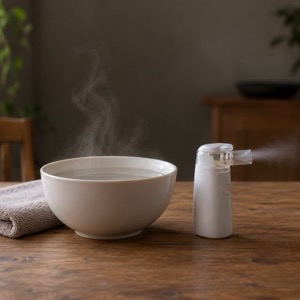
A battery mesh nebulizer is not a steamer. It turns the liquid in its cup into a cool mist that you breathe through a mouthpiece or mask, so there is no hot water to carry or spill and nothing to plug in while you use it. What it asks of a tour day is a charge beforehand and saline in your bag: sterile saline labeled for inhalation or nebulizer use, with anything prescribed going in only as your doctor directs.
The Mayluck MY139, sold by the company that owns this site, is one example. Its store listing (read October 8, 2026) describes a rechargeable mesh nebulizer with a built-in battery, a Type-C USB charging cable in the kit, and 10- or 20-minute timer settings. The kit includes no saline, and we have no verified battery-life or run-time figure for it, so we give none; charge it before a travel day. Mayluck's help center has a travel and storage page.
The limits are plain: a nebulizer is a purchase, saline is a separate purchase you keep making, and the saline evidence includes a null result.
What the studies measured
We found no study of steaming or nebulizing on tour, in a hotel room, on a bus or on a plane. The experiments in our research library are small, and they do not all point the same way:
| Study | Who | What was done | Result |
|---|---|---|---|
| Mahalingam & Boominathan, 2016 | 45 vocally healthy women | 3 minutes of steam after about 10 minutes of mouth breathing | Jitter, shimmer and harmonics-to-noise ratio moved back toward baseline |
| Keltz & McHenry, 2022 | 12 women, 7 analyzed | Steam and straw phonation in a morning warm-up | Highly variable: steam was best for 1 and worst for 3, who strongly disliked it |
| Tanner et al., 2010 | 34 classically trained sopranos | Nebulized isotonic saline or water after 15 minutes of dry air | Perceived effort returned to baseline only after the isotonic saline; phonation threshold pressure did not change significantly |
| Tanner et al., 2007 | 60 vocally healthy women | Nebulized saline or water after dry air | No nebulized treatment significantly improved recovery of phonation threshold pressure, a lab pressure measure |
| Levendoski et al., 2014 | 40 healthy adults | 2 hours of mouth breathing in low humidity and 2 hours in high humidity | Phonation threshold pressure rose after low humidity and returned toward baseline after high humidity |
| Sandage et al., 2014 | 15 adults | 20-minute exposures to five realistic temperature and humidity environments | No significant differences in phonation threshold pressure or perceived effort |
None of our sources measures the air in hotel rooms, buses or aircraft cabins, so we make no claim about how dry it is. If a room feels dry to you, Royal Berkshire's leaflet suggests a humidifier or a damp towel over the radiator; vocal steamer vs. humidifier covers room air.
When to stop and see a doctor
If steam makes you cough, stop and ask a doctor. Neither steam nor a nebulizer is a way to get through a run of shows with a voice problem that is not going away. The NIDCD says to see a doctor if you have been hoarse for more than three weeks (especially without a cold or flu), are coughing up blood, have trouble swallowing or breathing, feel a lump in your neck, have pain when speaking or swallowing, or lose your voice completely for more than a few days.
Questions
Can you steam your voice in a hotel room?
Yes, wherever you can heat water safely. The Hotel room section above sets out the bowl method from Guy's and St Thomas' and the steam-mug method from West Suffolk, which disagree on how hot the water should be.
Can you take a vocal steamer on a plane?
We do not state airline or airport-security rules, and we have no maker instruction on file about flying with a steamer. Ask your airline before you pack one.
How do you steam your voice while traveling with no kettle?
Going by the makers' documents we read, the cordless Mypurmist Free runs on its maker's sterile-water refills and the Crane EE-5948 takes drinking or spring water that is not hot. The Australian manual for the Vicks V1300 describes a pot you fill with hot (not boiling) tap water and mentions no power source (see the note on that model above). A battery nebulizer also needs no kettle, but it makes a cool saline mist, not steam.
Sources
- Mypurmist Free product page: manufacturer statements, checked October 11, 2026
- Mypurmist Free user guide (PDF): battery, run time, water and charger, checked October 11, 2026
- Crane EE-5948 Cordless Steam Inhaler product page: manufacturer statements, checked October 11, 2026
- Crane EE-5948 manual (PDF): battery, charging, run time and water, checked October 11, 2026
- Vicks VapoSteam Inhaler V1300-AUS use and care manual (PDF): Australian version, hosted by the Australian distributor, checked October 11, 2026
- Vicks Personal Steam Inhaler V1200 use and care manual (PDF): read from an Internet Archive capture of May 19, 2024, checked October 11, 2026
- Vicks steam inhalers listing: read from an Internet Archive capture of January 2, 2026, checked October 11, 2026
- Guy's and St Thomas' NHS Foundation Trust, "Recovering from vocal cord surgery": patient information page, written for people having vocal cord surgery
- West Suffolk NHS Foundation Trust, "Practical voice care": patient leaflet
- St George's University Hospitals NHS Foundation Trust, "Voice Care" (published October 2023): head and neck cancer patient leaflet
- Royal Berkshire NHS Foundation Trust, "Voice care tips for a healthy voice" (August 2025): patient leaflet
- Mahalingam & Boominathan, 2016, Laryngoscope (PubMed): 3 minutes of steam after mouth breathing, 45 women
- Keltz & McHenry, 2022, Journal of Voice (PubMed): steam and straw phonation in a morning warm-up, 12 women
- Tanner et al., 2010, Journal of Speech, Language, and Hearing Research (PubMed): nebulized saline and water after dry air, 34 sopranos
- Tanner et al., 2007, Journal of Speech, Language, and Hearing Research (PubMed): nebulized saline and water after dry air, 60 women
- Levendoski, Sundarrajan & Sivasankar, 2014, Annals of Otology, Rhinology & Laryngology (PubMed): mouth breathing in low and high humidity, 40 adults
- Sandage, Connor & Pascoe, 2014, Journal of Speech, Language, and Hearing Research (PubMed): five temperature and humidity environments, 15 adults
- NIDCD, "Hoarseness": when to see a doctor
- Mayluck MY139 product listing (mayluck.store): features and kit contents, read October 8, 2026