 VocalSteamer Editorial Team
You hydrate your vocal cords in two ways: by drinking enough fluid through the day, which researchers call systemic hydration, and by breathing moist air, which acts on the surface of the vocal folds and is called surface (or superficial) hydration. Drinking is the simpler of the two: a 2019 systematic review concluded that systemic hydration is "the easiest and most cost-effective solution" for voice quality, while steam, humid rooms and nebulized saline have mixed results in small studies, most of them short lab experiments.
NHS hospital leaflets give different drinking targets, and they disagree with that review about coffee. No method here is shown to make anyone sing better.
Two kinds of vocal fold hydration
Systemic hydration is the water in your body as a whole, and it comes from what you drink. Surface hydration is moisture at the vocal folds themselves, and it depends on the air passing over them: breathing through your mouth dries that surface, and steam, humid air and nebulized saline are the ways researchers have tried to put moisture back.
The Alves et al. review (Journal of Voice, 2019) appraised peer-reviewed studies on hydration and voice quality in adults from the previous 10 years. Its abstract does not say how many studies it included. It reports:
- Systemic: fasting without fluids significantly worsened several voice measures (jitter, shimmer, noise-to-harmonics ratio, frequency, s/z ratio); drinking water significantly improved shimmer, jitter, frequency and maximum phonation time. Caffeine intake did not appear to harm voice production.
- Surface: mouth breathing worsened acoustic measures, phonation threshold pressure (PTP, a lab pressure measure) and perceived effort. Steam significantly improved three acoustic measures; only nebulized isotonic solution decreased PTP (though in the single saline trials, Tanner 2007 found no nebulized treatment significantly sped PTP recovery, and Tanner 2010 and 2016 found no significant or consistent PTP change); high-humidity treatments were described as effective.
These are lab numbers, not a verdict on how a voice sounds to an audience, and the single saline trials are less tidy than the summary, as the saline section shows. Our research page lists every study used on this site.
Drinking water: what five NHS leaflets advise
These UK patient leaflets were checked October 11, 2026. Two were written for specific patients: Guy's and St Thomas' for people having vocal cord surgery, St George's for voice difficulties related to head and neck cancer treatment. For US readers, 2 liters is about 68 fluid ounces.
| NHS trust | How much | What counts, and how |
|---|---|---|
| Guy's and St Thomas' | 8 glasses or about 2 liters of water a day, "to keep your voice box hydrated" | Written for people having vocal cord surgery |
| Royal Berkshire | 2 liters | Water, sipped throughout the day |
| St George's | At least 2 liters daily, "if you can" | Counts herbal teas, fruit teas and water with squash (a diluted fruit drink); not tea, coffee, fruit juices, fizzy drinks or alcohol |
| West Suffolk | 6–8 glasses or mugs a day | Water, squash or herbal tea, spaced over the day; notes that American ENT doctors sometimes advise patients to "pee pale" |
| Sherwood Forest | "Plenty"; no figure | Do not wait to be thirsty; urine should be pale, almost clear |
Three name 2 liters, one counts glasses or mugs, and one uses urine color instead of a number. None gives a separate figure for singers or for a performance day, and we found no study that tested a daily amount for voice users.
Hydrating before singing
No leaflet or study in our sources says how long before singing to drink, or how much. The leaflets spread drinking across the day instead: Royal Berkshire says sip, West Suffolk says space it out, Sherwood Forest says do not wait until you are thirsty. Royal Berkshire also suggests a sip of water and a hard swallow instead of clearing your throat.
Coffee, tea and alcohol
Here the review and the leaflets point different ways. The Alves review reports that caffeine intake "does not appear to negatively affect voice production." Four of the five leaflets advise cutting back on or avoiding caffeine, and West Suffolk notes that it is a diuretic:
- Guy's and St Thomas': best to avoid alcohol and more than a couple of caffeinated drinks a day.
- Royal Berkshire: reduce caffeine and alcohol "as these are dehydrating."
- St George's: avoid alcohol and caffeinated drinks (coffee, tea, many fizzy drinks) "as they are very dehydrating."
- West Suffolk: tea and coffee contain caffeine, "which is a diuretic."
- Sherwood Forest: avoid excess caffeine in tea, coffee or cola, "as this can dry the throat."
Of these drinks, the review covers only caffeine; we found no study in our sources on alcohol and the voice, so that advice rests on the leaflets. If a clinician has given you a limit, follow theirs.
Surface hydration: steam
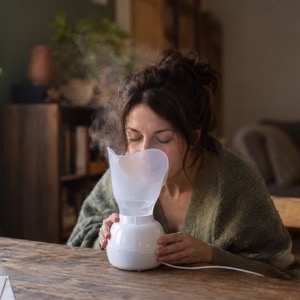
In a 2024 survey of 288 Canadian professional voice users (MacDonald, You & Fung), inhaling steam was one of the most common remedies, with hot drinks with honey and/or lemon, and lozenges; a survey shows what people use, not whether it works. Two experiments tested steam:
- Mahalingam & Boominathan, 2016 (45 vocally healthy women). About 10 minutes of mouth breathing worsened three acoustic measures; after 3 minutes of steam inhaled through the mouth, all three moved back toward baseline. Level of evidence 4.
- Keltz & McHenry, 2022 (12 women). A morning warm-up of 3 minutes of steam, straw-in-water phonation, or both. Results were highly variable: of 7 participants analyzed, steam was best for 1 and worst for 3, who strongly disliked it.
Neither study measured moisture on the vocal folds. The leaflets sound more certain: Royal Berkshire suggests steam "to soothe a dry throat," and West Suffolk says that before bed it can help restore the moisture balance of the vocal folds. Those are leaflet statements, not trial results. Session lengths run from 2–3 minutes (St George's) to 10–15 (West Suffolk); see how long to steam your voice and does steam help vocal cords?
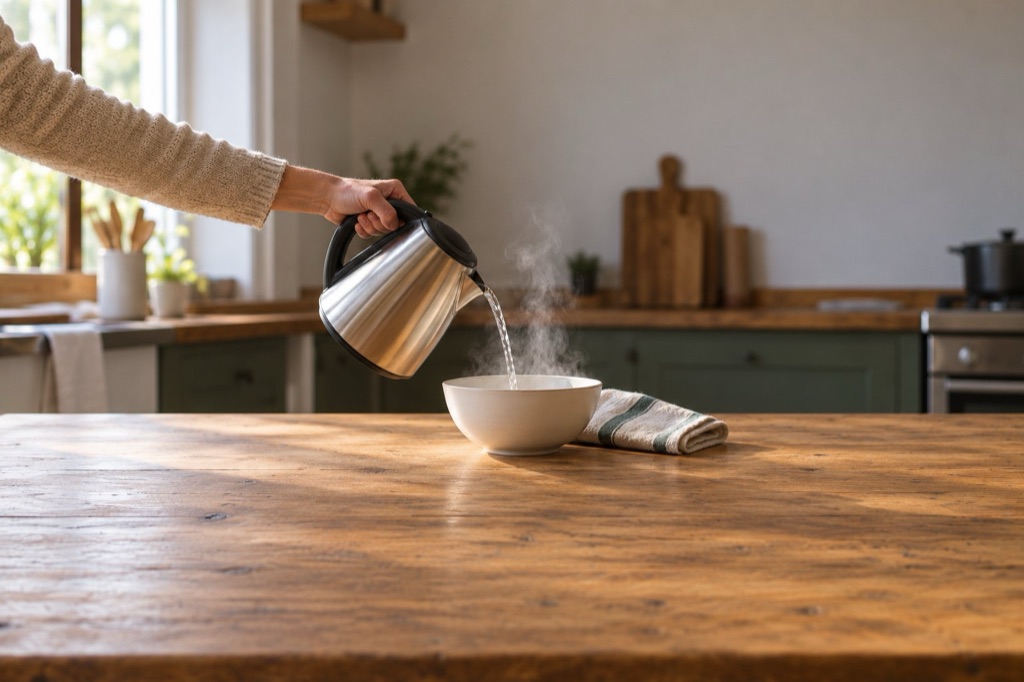
Steam means hot water. Guy's and St Thomas' says not to use water that has just boiled and to keep your head a safe distance from the bowl; West Suffolk asks for just-boiled water and says to be extremely careful.
Surface hydration: room humidity
Three studies tested humid air, with three different results:
| Study | Who and what | Result |
|---|---|---|
| Levendoski, Sundarrajan & Sivasankar, 2014 | 40 healthy adults; 2 hours of mouth breathing in low humidity, then 2 hours in high humidity | PTP rose after the dry air and returned toward baseline after the humid air |
| Sundarrajan et al., 2017 | 13 healthy adults over 65; 45 minutes of loud speech in noise, in low and in moderate humidity | Moderate humidity significantly alleviated the rise in perceived effort and vocal tiredness; not reported for PTP |
| Sandage, Connor & Pascoe, 2014 | 15 adults; 20 minutes in each of five realistic temperature and humidity environments | No significant differences in PTP or perceived effort |
For your home, the NIDCD suggests a humidifier and about 30% humidity. Royal Berkshire suggests a humidifier or a damp towel over the radiator; St George's, a bowl of hot water in the corner of the room at night; Sherwood Forest, houseplants or bowls of water. Vocal steamer vs. humidifier compares the devices.
Surface hydration: nebulized saline
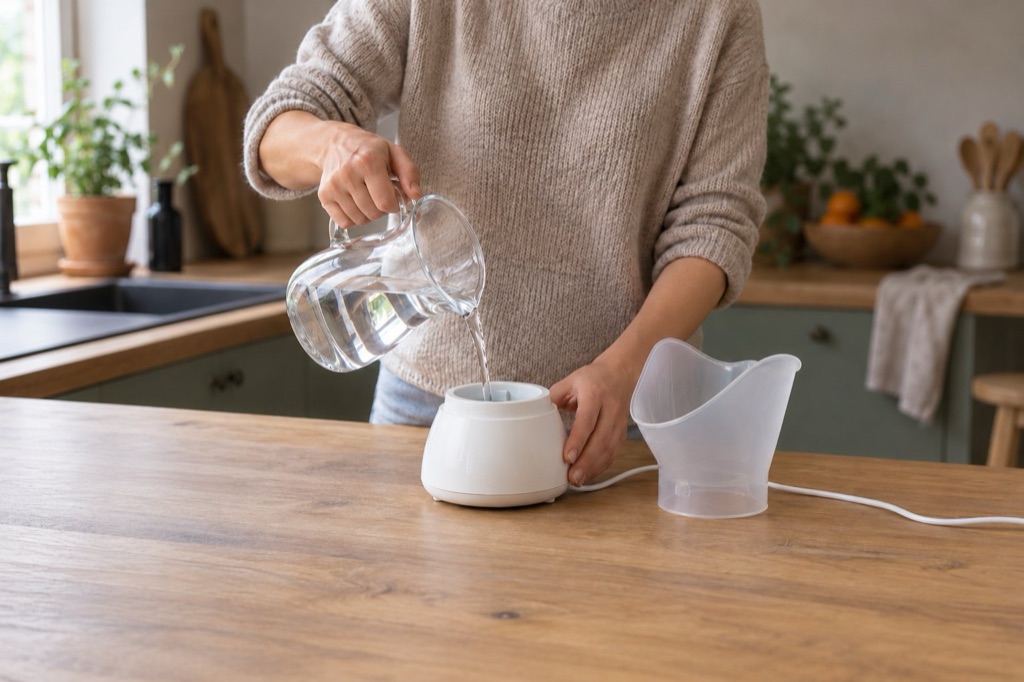
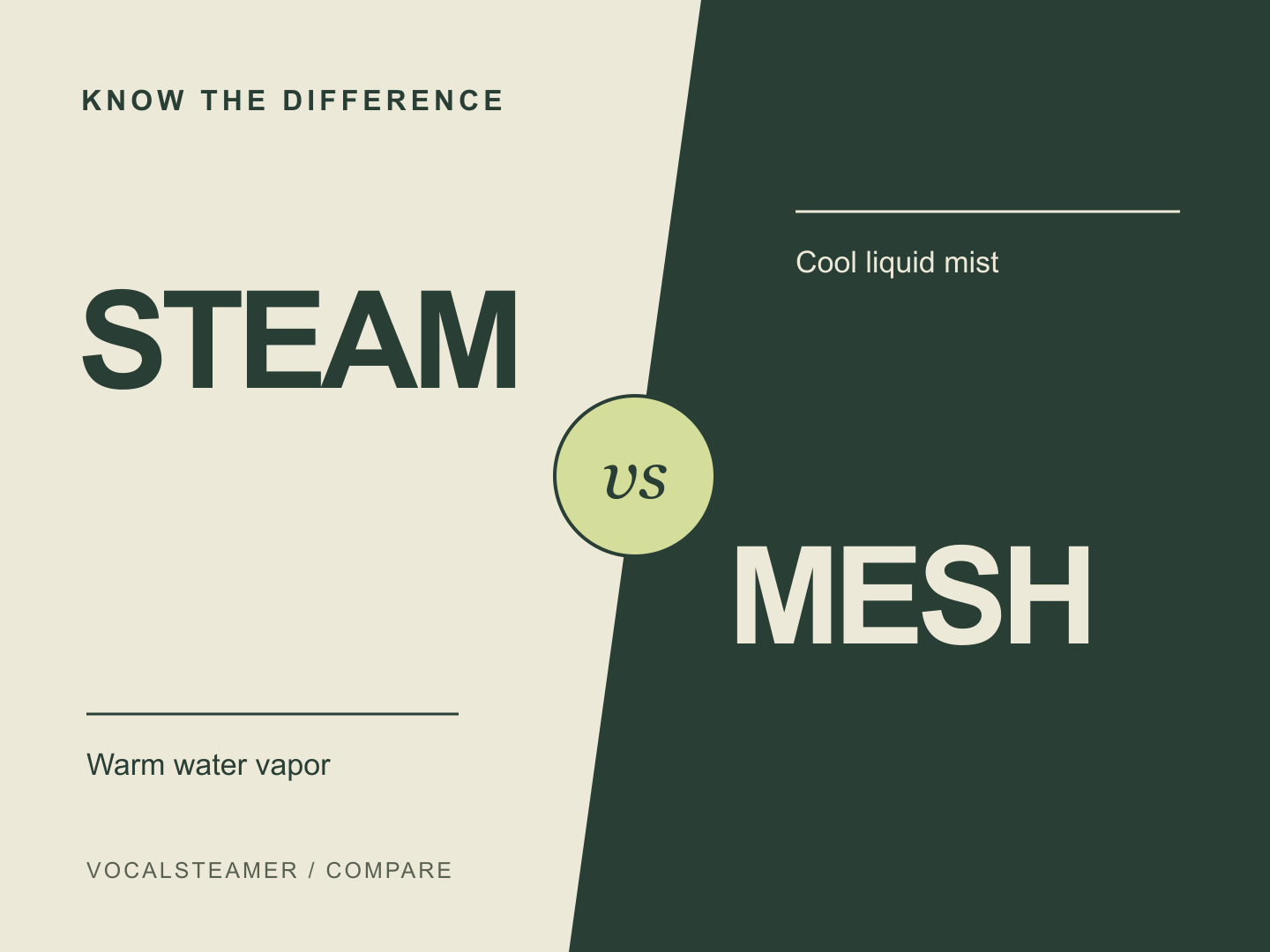
A nebulizer turns the liquid in its cup into a mist; it is not a steamer (vocal steamer vs. nebulizer). Saline mist has the most trials of any surface method in our sources, and mixed results:
| Study | Who and what | Result |
|---|---|---|
| Tanner et al., 2007 | 60 vocally healthy women; 15 minutes of very dry air, then nebulized isotonic or hypertonic saline, sterile water or nothing | No nebulized treatment significantly sped PTP recovery |
| Tanner et al., 2010 | 34 classically trained sopranos; the same dry-air challenge, then isotonic saline, sterile water or nothing | Self-rated effort returned to baseline after saline only; PTP did not change significantly |
| Tanner et al., 2016 | 20 young men, half trained singers; 30 minutes of dry air, then isotonic saline | Self-rated effort and dryness improved; no consistent change in PTP or an acoustic measure |
| Santana, Masson & Araújo, 2017 | 27 teachers, a single group; daily for 4 weeks, mouth breathing then 5 minutes of saline mist | Listener-rated change not statistically significant; some acoustic changes were; the authors concluded voice quality improved |
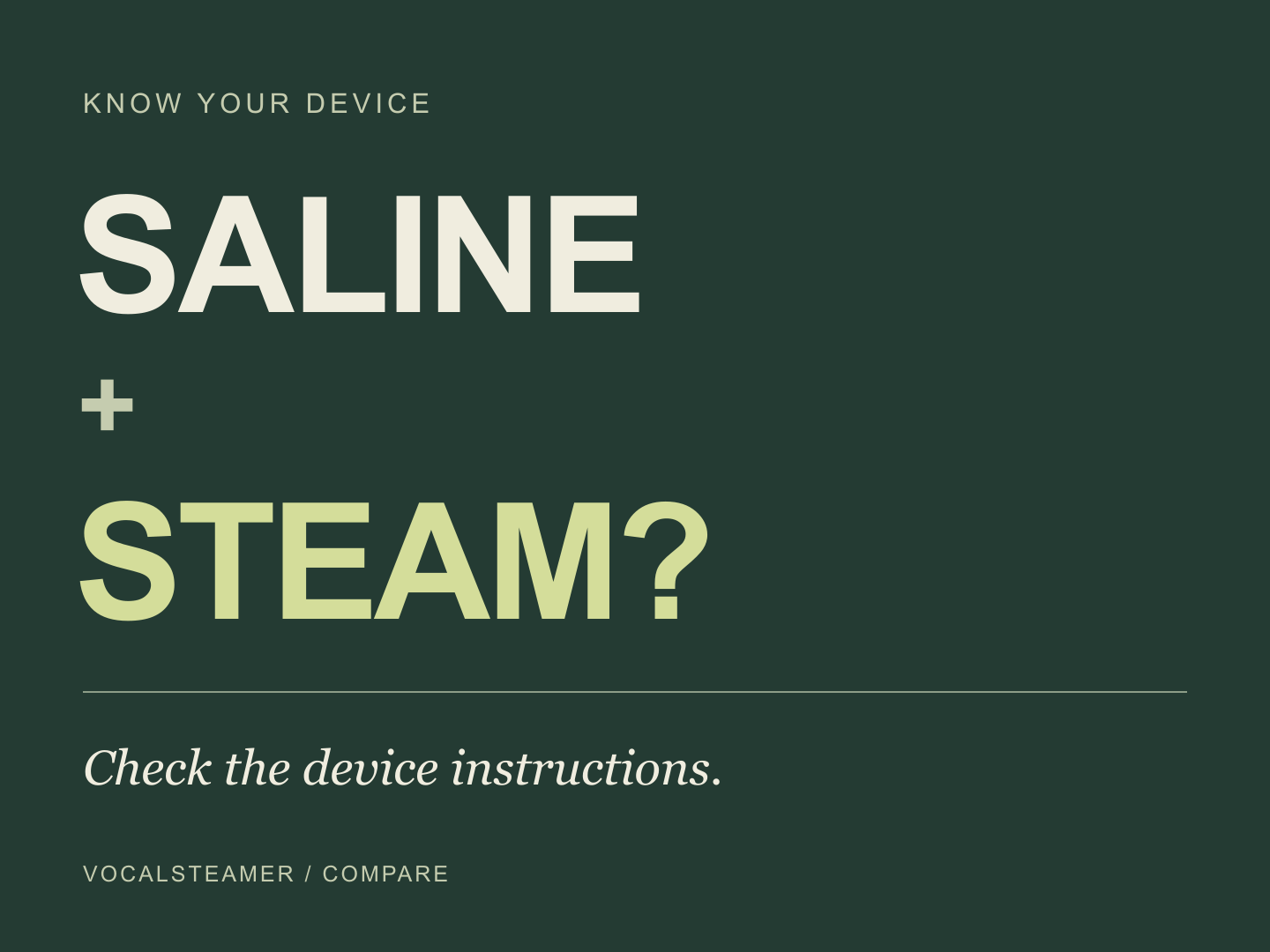
In some of these studies people reported less effort or dryness after saline mist, while the pressure measure mostly did not move. Saline for a nebulizer should be sterile and labeled for inhalation or nebulizer use; this guide gives no amounts, and for anything prescribed, ask your doctor. See vocal steamer with saline and mesh nebulizer for singers.
For saline mist away from a kettle or an outlet, Kinmilu, sold by a company affiliated with this site's owner, lists a rechargeable portable mesh nebulizer.
When to see a doctor
Drinking water and breathing moist air are everyday habits, not a treatment. The NIDCD says to see a doctor if you have been hoarse for more than three weeks (especially without a cold or flu), are coughing up blood, have trouble swallowing or breathing, feel a lump in your neck, have pain when speaking or swallowing, or lose your voice completely for more than a few days. If steam or mist makes you cough, stop and see a doctor. Nothing here is a recommendation for children.
Questions
Does drinking water help your voice?
In a 2019 systematic review (Alves et al.), drinking water was linked to significant improvements in lab voice measures such as shimmer, jitter and maximum phonation time, and fasting without fluids made several measures worse. No source we found shows that extra water makes anyone sing better.
How much water should singers drink?
No source we found gives a figure for singers. NHS voice leaflets range from "plenty" with pale urine (Sherwood Forest) to 6–8 glasses or mugs a day (West Suffolk), 2 liters (Royal Berkshire), about 2 liters for people after vocal cord surgery (Guy's and St Thomas') and at least 2 liters, if you can, for people with voice difficulties related to head and neck cancer treatment (St George's). Two liters is roughly 68 US fluid ounces. If a doctor has given you a figure, use theirs.
Does steam hydrate vocal cords?
No study we found measured moisture on the vocal folds after steam. In one study of 45 women, 3 minutes of steam after mouth breathing moved acoustic measures back toward baseline; in another, steam as a morning warm-up gave highly variable results: of 7 women analyzed, steam was the worst condition on the pressure measure for 3, who also strongly disliked it.
Does coffee dehydrate your voice?
The sources disagree. A 2019 systematic review reports that caffeine does not appear to harm voice production, while four NHS voice leaflets advise limiting or avoiding it and a fifth (West Suffolk) calls caffeine a diuretic, and Royal Berkshire and St George's call it dehydrating.
Sources
- NHS patient leaflets, all checked October 11, 2026: Guy's and St Thomas', "Recovering from vocal cord surgery"; Royal Berkshire, "Voice care tips for a healthy voice"; St George's, "Voice Care" (head and neck cancer leaflet); West Suffolk, "Practical voice care"; Sherwood Forest, "Vocal hygiene: Caring for your voice"
- Alves et al., 2019, Journal of Voice (systematic review): PubMed abstract, read October 13, 2026
- MacDonald, You & Fung, 2024, Journal of Voice (survey): PubMed abstract, read October 13, 2026
- Mahalingam & Boominathan, 2016, The Laryngoscope: PubMed abstract, read October 13, 2026
- Keltz & McHenry, 2022, Journal of Voice: PubMed abstract, read October 13, 2026
- Levendoski et al., 2014, Annals of Otology, Rhinology & Laryngology: PubMed abstract, read October 13, 2026
- Sundarrajan et al., 2017, Journal of Voice: PubMed abstract, read October 13, 2026
- Sandage et al., 2014, Journal of Speech, Language, and Hearing Research: PubMed abstract, read October 13, 2026
- Tanner et al., 2007, Journal of Speech, Language, and Hearing Research: PubMed abstract, read October 13, 2026
- Tanner et al., 2010, Journal of Speech, Language, and Hearing Research: PubMed abstract, read October 13, 2026
- Tanner et al., 2016, Journal of Voice: PubMed abstract, read October 13, 2026
- Santana et al., 2017, Journal of Voice: PubMed abstract, read October 13, 2026
- NIDCD pages "Taking Care of Your Voice" and "Hoarseness": US government voice-care and when-to-see-a-doctor guidance, re-opened October 11, 2026
- Kinmilu MY139 product listing: features and kit contents, re-read October 25, 2026