

 VocalSteamer Editorial Team
Voice care for teachers starts with three habits the NIDCD lists: drink water, take "vocal naps" (its term for resting your voice), and use a humidifier. Steam and saline mist are optional extras, and the research on them is thin: the one study in our research library that recruited schoolteachers used nebulized saline, not steam, and its result on overall voice alteration was not statistically significant.
We have not tested any steamer or nebulizer. This guide draws on study abstracts, NIDCD and EPA pages, NHS hospital leaflets and manufacturers' own documents.
Everyday voice habits for a teaching day
The NIDCD's "Taking Care of Your Voice" page says to drink water, take vocal naps, and use a humidifier, with about 30% humidity as its figure. NHS patient leaflets on voice care add detail, and their figures do not always match:
- Water. Royal Berkshire says to aim for 2 liters, sipped throughout the day, and to reduce caffeine and alcohol. West Suffolk says 6 to 8 glasses or mugs of water, squash or herbal tea, spaced over the day.
- Rest. Sherwood Forest Hospitals says that if your throat starts to hurt or your voice deteriorates, rest your voice for 30 minutes to an hour. Royal Berkshire says to rest it when you have a cold or sore throat.
- Dry air. Royal Berkshire suggests a humidifier or a damp towel over the radiator. For a humidifier at home, the EPA says not to go above 50% relative humidity and to empty, wipe dry and refill a portable unit daily. See vocal steamer vs. humidifier.

What the research covers, and who was studied
Only one study in our library recruited schoolteachers. Santana, Masson and Araújo (Journal of Voice, 2017) studied 27 public-school teachers in Brazil who nebulized 0.9% saline for 5 minutes a day before teaching, for four weeks (after 10 minutes of mouth breathing, according to the abstract). The reduction in overall voice alteration was not statistically significant. Some acoustic measures changed significantly (the mean fundamental frequency of a vowel rose, and intensity measures of connected and spontaneous speech fell), and the authors concluded there was improvement.
So the result on overall voice alteration was a null one, in 27 people over four weeks. The study did not involve steam, and the abstract does not state which nebulizer it used.
Other studies in our library are small and were not studies of teachers:
| Study | Who and what | Result |
|---|---|---|
| Tanner et al., 2007 (saline) | 60 vocally healthy women; 15 minutes of dry air, then nebulized isotonic saline, hypertonic saline, sterile water or no treatment | No nebulized treatment significantly enhanced recovery of phonation threshold pressure (PTP), a pressure measure; a temporary trend toward lower PTP with isotonic saline |
| Mahalingam & Boominathan, 2016 (steam) | 45 vocally healthy women aged 18 to 30; about 10 minutes of mouth breathing, then 3 minutes of steam through the mouth from a facial steamer | Jitter, shimmer and harmonics-to-noise ratio moved back toward baseline. Level of evidence 4 |
| Keltz & McHenry, 2022 (steam) | 12 women; morning warm-up with 3 minutes of steam, 3 minutes of straw-in-water phonation, or both | Highly variable; of 7 analyzed participants, steam was best for 1 and worst for 3, who strongly disliked it |
| Sundarrajan et al., 2017 (humidity) | 13 healthy adults over 65; 45 minutes of loud child-directed speech in background noise | Moderate ambient humidity significantly alleviated the rise in perceived effort and vocal tiredness |
| Sandage et al., 2014 (humidity) | 15 adults; 20-minute exposures to five realistic temperature and humidity environments | No significant differences in PTP or perceived effort |
Two more nebulized-saline studies are on the research page: Tanner et al., 2010, in 34 classically trained sopranos, and Tanner et al., 2016, in 10 trained male singers and 10 nonsingers. We found no study of steam in schoolteachers.
A 2024 Canadian survey of 288 professional voice users from ACTRA, NATS, Canadian Actors' Equity and vocal performance at Western University (MacDonald, You & Fung) found that 86% had used at least one complementary or alternative remedy when experiencing voice loss or a negative voice change, most commonly hot drinks with honey and/or lemon, lozenges, and inhaling steam. That shows what people use, not whether it works.
What hospital leaflets say about steam
NHS hospital leaflets describe steam inhalation, but they disagree on how long and how often, and two were written for specific patient groups.
| NHS trust | Leaflet | Session | How often |
|---|---|---|---|
| St George's University Hospitals | For people with voice difficulties related to head and neck cancer treatment | 2 to 3 minutes | 3 to 4 times a day |
| Guy's and St Thomas' | For people having vocal cord surgery; guidance for at least the first 2 weeks after | 5 to 10 minutes | Every day |
| Royal Berkshire | For people with voice difficulties | 10 minutes | Twice a day |
| West Suffolk | Speech and language therapy leaflet; describes a steam-inhaling mug | 10 to 15 minutes | Once or twice a day |
| Sherwood Forest Hospitals | Ear, nose and throat department leaflet | Not stated | Not stated |
None of the five cites a study comparing durations, and none says how long to wait after steaming before you talk. How long to steam your voice compares them in full.
Fitting steam or mist into a school day
At home, before or after work
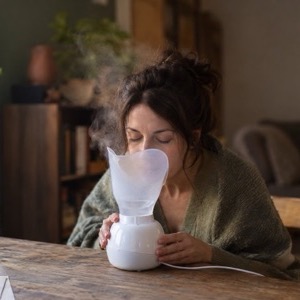
Steam fits here: you have a kettle, a steady surface and time to sit. West Suffolk's leaflet suggests steam before bed and calls it a "night-time moisturiser" after you have been out in a noisy or smoky environment. For mornings, remember the Keltz & McHenry warm-up study, where results varied and some participants disliked steam. How to use a vocal steamer has the steps.
At school
A bowl or steam mug needs hot water, a steady surface and the minutes in the table above, and hot water near students is a scald risk. Two kinds of device avoid the kettle:
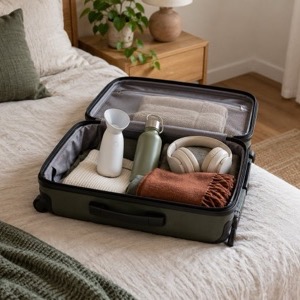
- A cordless steam inhaler. MyPurMist calls its Free model cordless; its user guide says a full charge provides 30 minutes of use and that it works only with the maker's sealed sterile-water refills (manufacturer's statements, checked October 11, 2026). See portable vocal steamers.
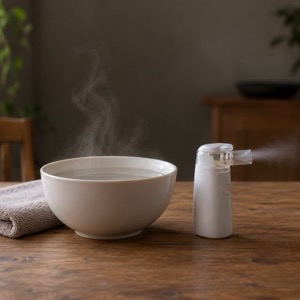
- A battery nebulizer. It makes a cool mist from saline, and a rechargeable one needs no outlet (vocal steamer vs. nebulizer compares the two). The teacher study nebulized saline before teaching; its result on overall voice alteration was not statistically significant, and it was not a test of any product. One example is the Mayluck MY139, sold by the company that owns this site and described in the card below. Use sterile saline labeled for inhalation or nebulizer use; anything prescribed goes in only as your doctor directs. The Mayluck store has an article on using a portable nebulizer at work.
Neither device is necessary: drinking water and resting your voice need no equipment.
When to see a doctor
None of this is a way to manage a voice problem that is not going away. The NIDCD says to see a doctor if you have been hoarse for more than three weeks (especially without a cold or flu), are coughing up blood, have trouble swallowing or breathing, feel a lump in your neck, have pain when speaking or swallowing, or lose your voice completely for more than a few days. If steam or mist makes you cough, stop and see a doctor.
Questions
Do teachers need a vocal steamer?
We found no study of steam in schoolteachers, so nothing shows that a teacher needs one. NHS leaflets describe steaming with a bowl and towel or with a steam-inhaling mug, which West Suffolk's leaflet (issued August 17, 2026) says you can buy for less than £10 from most large chemists (pharmacies). What is a vocal steamer? covers the electric types.
Should you steam your voice before teaching?
The research does not settle it: in the one morning warm-up study in our library (Keltz & McHenry, 2022), results were highly variable. The study table above has the details.
What should a teacher do when losing their voice?
The NIDCD says to see a doctor if you lose your voice completely for more than a few days or stay hoarse for more than three weeks. Two hospital leaflets say when to rest your voice; see "Everyday voice habits for a teaching day" above.
Is voice care different for lecturers and public speakers?
We found no study of lecturers or public speakers as a group. The NIDCD's habits and its see-a-doctor list are the place to start for any job with hours of talking.
Sources
- Santana, Masson & Araújo, 2017, Journal of Voice (PubMed): nebulized saline in 27 public-school teachers over 4 weeks
- Tanner et al., 2007, Journal of Speech, Language, and Hearing Research (PubMed): nebulized saline and water after dry air, 60 women
- Tanner et al., 2010, Journal of Speech, Language, and Hearing Research (PubMed): nebulized isotonic saline in 34 sopranos
- Tanner et al., 2016, Journal of Voice (PubMed): nebulized saline in 10 male singers and 10 nonsingers
- Mahalingam & Boominathan, 2016, Laryngoscope (PubMed): steam after mouth breathing, 45 women
- Keltz & McHenry, 2022, Journal of Voice (PubMed): steam and straw phonation in a morning warm-up, 12 women
- Sundarrajan et al., 2017, Journal of Voice (PubMed): ambient humidity and loud speech, 13 adults over 65
- Sandage, Connor & Pascoe, 2014, Journal of Speech, Language, and Hearing Research (PubMed): five temperature and humidity environments, 15 adults
- MacDonald, You & Fung, 2024, Journal of Voice (PubMed): survey of 288 professional voice users in Canada
- NIDCD, "Taking Care of Your Voice": everyday voice habits
- NIDCD, "Hoarseness": when to see a doctor
- EPA, "Use and Care of Home Humidifiers": humidity limit and daily care for home humidifiers
- Royal Berkshire NHS Foundation Trust, "Voice care tips for a healthy voice" (August 2025): patient leaflet
- West Suffolk NHS Foundation Trust, "Practical voice care" (issued August 17, 2026): patient leaflet
- Sherwood Forest Hospitals NHS Foundation Trust, "Vocal hygiene: Caring for your voice" (revised December 2025): patient leaflet
- St George's University Hospitals NHS Foundation Trust, "Voice Care" (published October 2023): head and neck cancer patient leaflet
- Guy's and St Thomas' NHS Foundation Trust, "Recovering from vocal cord surgery": patient information page, written for people having vocal cord surgery
- MyPurMist Free product page: manufacturer statements, checked October 11, 2026
- MyPurMist Free user guide (PDF): manufacturer statements, checked October 11, 2026
- Mayluck MY139 product listing (mayluck.store): features and kit contents, read October 8, 2026