

 VocalSteamer Editorial Team
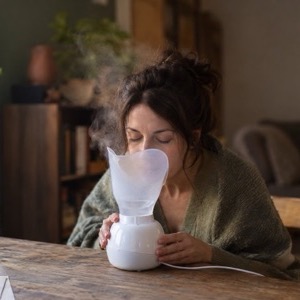
A vocal steamer for actors is simplest to use at home: a bowl of hot water or a plug-in steam inhaler needs a kettle or an outlet and a steady surface, which a rehearsal room or a shared dressing room may not have. Two makers also list battery-powered steam inhalers, covered below. We found no study that tested steam on actors as a group, so this guide relies on small studies of other groups, one survey of professional voice users, hospital leaflets and makers' documents.
We did not test any steamer named here hands-on. For the product section we compared manufacturers' specifications and instructions, current prices (checked October 11, 2026) and published buyer ratings where a source is recorded.
Where steam fits in an actor's day
At home, before and after
Whether to steam before you leave home is not settled: the one morning warm-up study in our research library had mixed results. For the evening, West Suffolk NHS Foundation Trust's leaflet describes steaming before bed, including after time somewhere noisy or smoky. NHS leaflets disagree on how long a session should last; how long to steam your voice compares them, and how to use a vocal steamer has the steps.

In the rehearsal room
A rehearsal day means hours of talking, in a room where an open bowl of hot water is a scald risk. Voice care for actors here needs no equipment: the NIDCD's voice-care page includes drinking water and resting your voice, and Sherwood Forest Hospitals' leaflet says to rest your voice for 30 minutes to an hour if your throat starts to hurt or your voice deteriorates.
In a shared dressing room
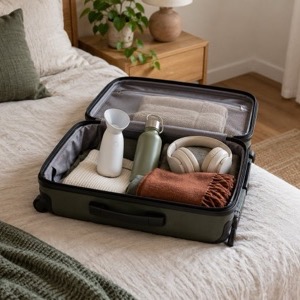
Before a show, the limits are an outlet within reach, table space and the people beside you. A bowl of hot water on a crowded table is a scald risk for your neighbor as well as you, and so is a plug-in unit that boils its own water. Cordless options are covered below.
Steaming your voice as an actor: what the research covers
Four studies in our library come closest to an actor's working day:
| Study | Who | What was done | Result |
|---|---|---|---|
| Keltz & McHenry, 2022 | 12 women, 7 analyzed | Morning warm-up with 3 minutes of steam, 3 minutes of straw-in-water phonation, or both | Highly variable; steam was best for 1 and worst for 3, who strongly disliked it |
| Sundarrajan et al., 2017 | 13 healthy adults over 65 | 45 minutes of loud child-directed speech in background noise | Moderate ambient humidity significantly alleviated the rise in perceived effort and vocal tiredness |
| Sandage, Connor & Pascoe, 2014 | 15 adults | 20-minute exposures to five realistic temperature and humidity environments | No significant differences in phonation threshold pressure (a pressure measure) or perceived effort |
| MacDonald, You & Fung, 2024 | 288 professional voice users in Canada, from ACTRA, NATS, Canadian Actors' Equity and vocal performance at Western University | Survey of products and therapies used to improve vocal health | 86% had used at least one complementary or alternative remedy when experiencing voice loss or a negative voice change; the most common were hot drinks with honey and/or lemon, lozenges, and inhaling steam |
One other small steam study (Mahalingam & Boominathan, 2016) saw voice measures move back toward baseline after 3 minutes of steam in 45 vocally healthy women who had been mouth breathing; does steam help vocal cords? covers both steam studies. Sundarrajan et al. is the closest to a long scene, but it concerned the room's humidity, not a steamer, and Sandage et al. found no significant differences. The survey shows what people use, not whether it works.
We found no study of steaming before a performance, and none that followed a voice through a rehearsal day or a run of shows; the longest speaking task above lasted 45 minutes.
Theater air
None of our sources measures the air in theaters or rehearsal rooms, so we make no claim about how dry yours is. Vocal steamer vs. humidifier covers the air at home.
Best vocal steamer for actors: home or backstage, by listed features
We name no best steamer, because we did not test any. The features below are the makers' own statements, checked October 11, 2026 (the Vicks manual in an Internet Archive copy captured May 19, 2024).
| Device | Fits | What the maker lists | Price |
|---|---|---|---|
| Vicks Personal Steam Inhaler V1200 | Home | Plugs directly into a wall outlet and boils tap water. The manual says it takes approximately 3 to 5 minutes to begin making steam, must not be moved in use and is for residential use only | $59.99 at Amazon.com; no maker's price found |
| Mypurmist Free | A dressing room with no outlet | Built-in battery; a full charge gives 30 minutes of use; does not operate while plugged in; takes only the maker's sealed sterile-water refills; the maker states 100 to 115°F and no scalding risk | $179.95 at mypurmist.com (base kit) |
| Crane EE-5948 Cordless Steam Inhaler | A dressing room with no outlet | 1800 mAh battery; 15 minutes per session, then it turns itself off; warm steam and cool mist modes; clean drinking or spring water, not hot or distilled | $89.99 at crane-usa.com |
Prices are the sellers' figures for October 11, 2026, and they change. Public ratings that day: the V1200, 4.3 out of 5 from 7,919 ratings on Amazon.com; the Mypurmist Free, 3.8 from 793 and 4.1 from 141 on its two Amazon.com kit listings; and the Target.com listing titled "Crane Personal Cool & Warm Mist Cordless Inhaler - 30ml", which shows the model number EE-5948 only as the title of a product video, 3.97 out of 5 from 33 ratings.
We recorded no buyer comments for the V1200 or the Mypurmist Free. In the 8 most recent of the 31 written reviews on that Target.com listing (May 2022 to November 2025), 4 said the warm setting was cool or barely warm, 2 said the unit stopped working or leaked early, 2 praised the cordless use and 2 questioned the price.
For a face in makeup, Mypurmist sells a Vocal Wand for the Free ($12.95 for a pack of 5 at mypurmist.com on October 11, 2026) that it says directs warm mist toward the throat without affecting makeup, hair or skin.
More devices: portable vocal steamers and best vocal steamer for singers.
No kettle and no outlet: a battery nebulizer for saline mist
A nebulizer is not a steamer: it turns the liquid in its cup into a cool mist, and a rechargeable one runs away from an outlet (vocal steamer vs. nebulizer compares them). The saline voice studies used nebulizers, with mixed results. Two small lab studies had participants breathe dry air for 15 minutes first: in 34 classically trained sopranos, perceived effort returned to baseline only after nebulized isotonic saline, not after sterile water or no treatment, and phonation threshold pressure did not change significantly (Tanner et al., 2010); in 60 vocally healthy women, no nebulized treatment significantly sped recovery of phonation threshold pressure (Tanner et al., 2007).
One example is the MY139 from Kinmilu, a store run by a company affiliated with this site's owner (card below). Its kit includes no saline: use sterile saline labeled for inhalation or nebulizer use, and for anything prescribed, ask your doctor.
When to stop and see a doctor
If steam or mist makes you cough, stop and see a doctor. The NIDCD says to see a doctor if you have been hoarse for more than three weeks (especially without a cold or flu), are coughing up blood, have trouble swallowing or breathing, feel a lump in your neck, have pain when speaking or swallowing, or lose your voice completely for more than a few days.
Questions
What is the best vocal steamer for actors?
We name none: we did not test any, and we found no study comparing models. By makers' listed features, a plug-in steam inhaler suits home and a cordless one suits a dressing room with no free outlet.
Should actors steam their voice before a show?
No study we found tested it. The nearest is the morning warm-up study above, with its mixed results, and none of the five NHS leaflets we read gives a waiting time between steaming and speaking.
Do actors use vocal steamers?
We have no figures for steamer devices or for actors alone. The nearest evidence is the 2024 Canadian survey above: among 288 professional voice users drawn from ACTRA, NATS, Canadian Actors' Equity and vocal performance at Western University, inhaling steam was one of the most common complementary or alternative remedies used, and voice teachers and doctors most often influenced the choice.
Sources
- Keltz & McHenry, 2022, Journal of Voice (PubMed): steam and straw phonation in a morning warm-up, 12 women
- Mahalingam & Boominathan, 2016, Laryngoscope (PubMed): steam after mouth breathing, 45 women
- Sundarrajan et al., 2017, Journal of Voice (PubMed): ambient humidity and 45 minutes of loud speech, 13 adults over 65
- Sandage, Connor & Pascoe, 2014, Journal of Speech, Language, and Hearing Research (PubMed): five temperature and humidity environments, 15 adults
- MacDonald, You & Fung, 2024, Journal of Voice (PubMed): survey of 288 professional voice users in Canada
- Tanner et al., 2010, Journal of Speech, Language, and Hearing Research (PubMed): nebulized isotonic saline in 34 sopranos
- Tanner et al., 2007, Journal of Speech, Language, and Hearing Research (PubMed): nebulized saline and water after dry air, 60 women
- NIDCD, "Taking Care of Your Voice": everyday voice habits
- NIDCD, "Hoarseness": when to see a doctor
- West Suffolk NHS Foundation Trust, "Practical voice care" (issued August 17, 2026): patient leaflet; steam before bed
- Sherwood Forest Hospitals NHS Foundation Trust, "Vocal hygiene: Caring for your voice" (revised December 2025): patient leaflet; resting the voice
- The other three NHS sources behind the statements about the five leaflets: Royal Berkshire NHS Foundation Trust, "Voice care tips for a healthy voice" (August 2025); St George's University Hospitals NHS Foundation Trust, "Voice Care" (published October 2023), a head and neck cancer patient leaflet; Guy's and St Thomas' NHS Foundation Trust, "Recovering from vocal cord surgery", a page for people having vocal cord surgery
- Vicks Personal Steam Inhaler V1200, Use and Care Manual (Kaz USA): manufacturer manual, read on October 11, 2026 from the Internet Archive capture of May 19, 2024; the live Vicks site did not load for our check that day
- Mypurmist Free product page and user guide (PDF): manufacturer statements and price, checked October 11, 2026
- Mypurmist Vocal Wand product page: manufacturer statements and price, checked October 11, 2026
- Crane EE-5948 Cordless Steam Inhaler product page and manual (PDF): manufacturer statements and price, checked October 11, 2026
- Amazon.com listing for the Vicks V1200: price and rating, October 11, 2026
- Amazon.com listings for the Mypurmist Free Essential Kit and Premium Kit: ratings, October 11, 2026
- Target.com listing titled "Crane Personal Cool & Warm Mist Cordless Inhaler - 30ml": rating and buyer reviews, October 11, 2026
- Kinmilu MY139 product listing (kinmilu.com): features and kit contents, read October 11, 2026